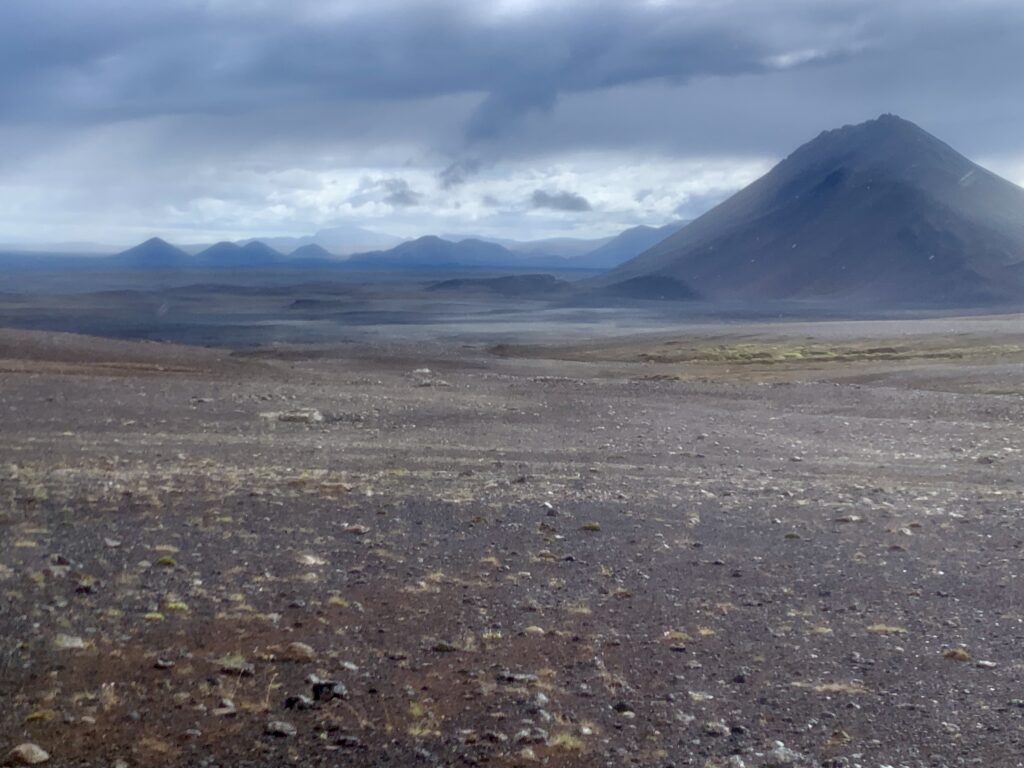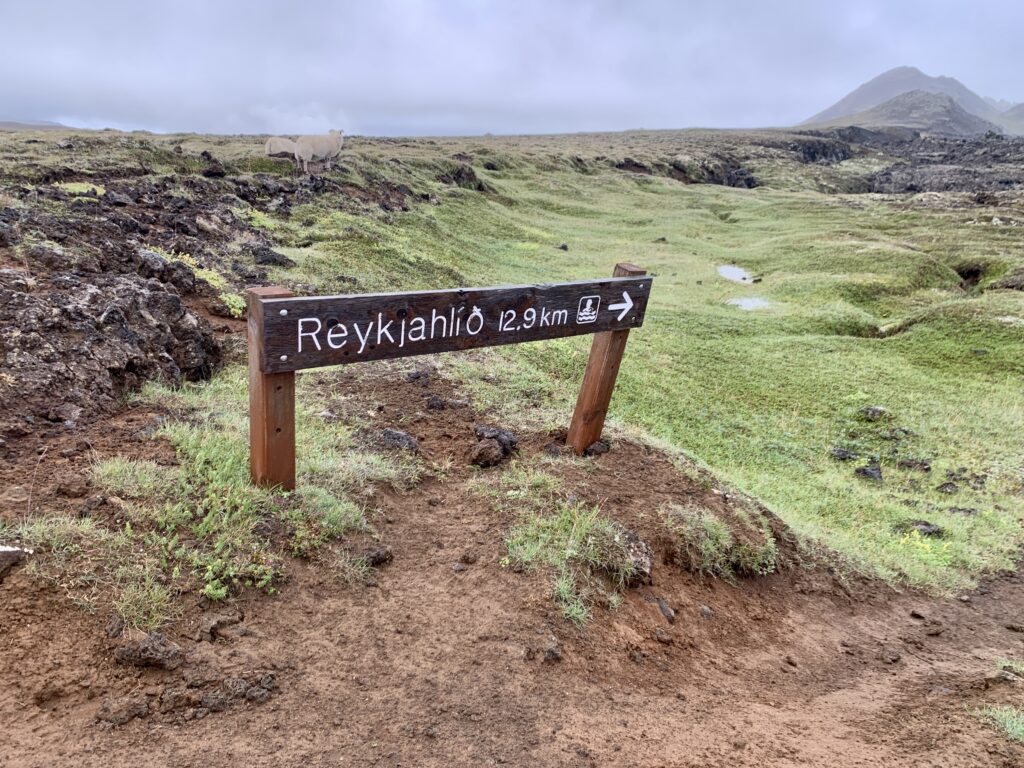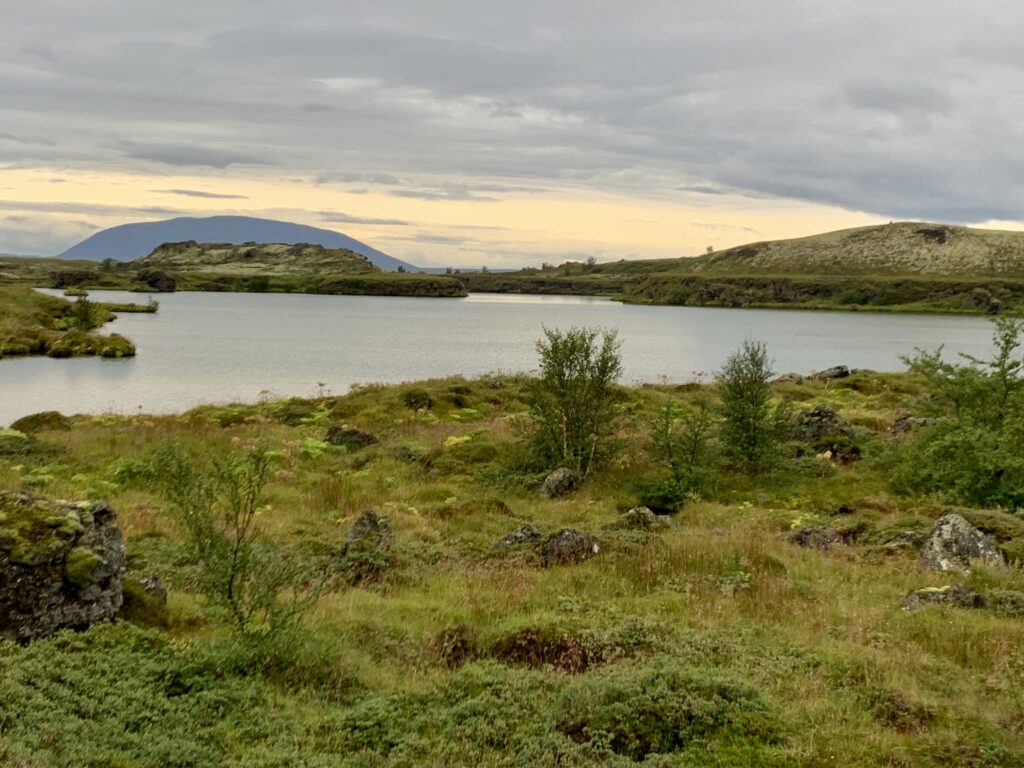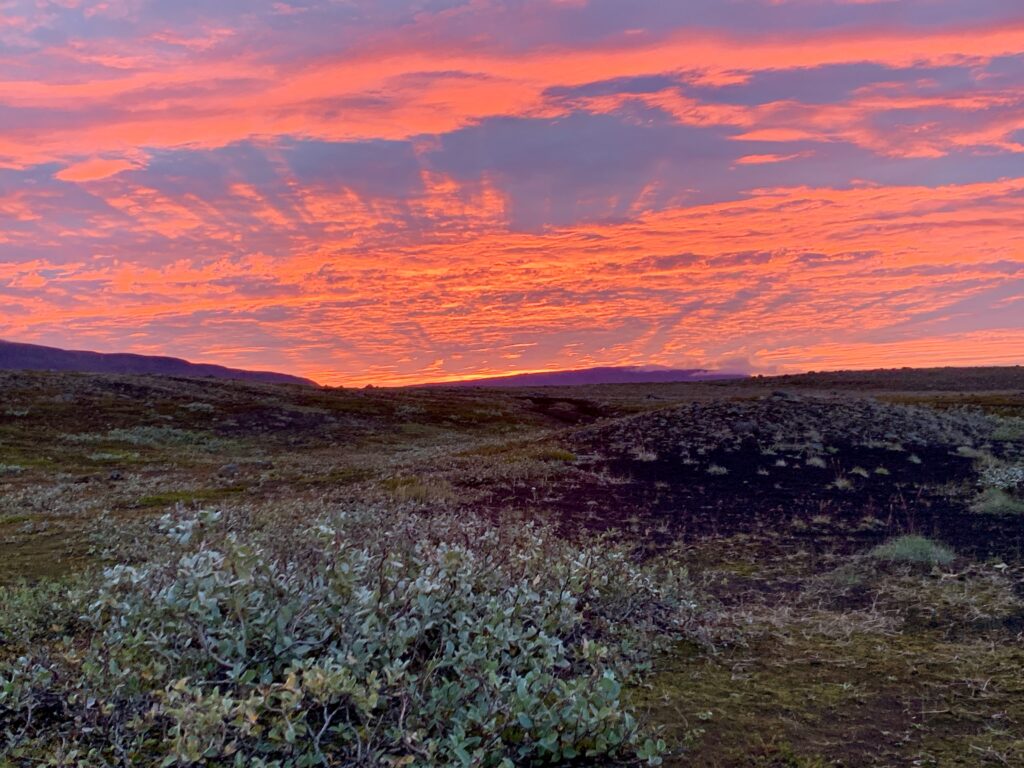
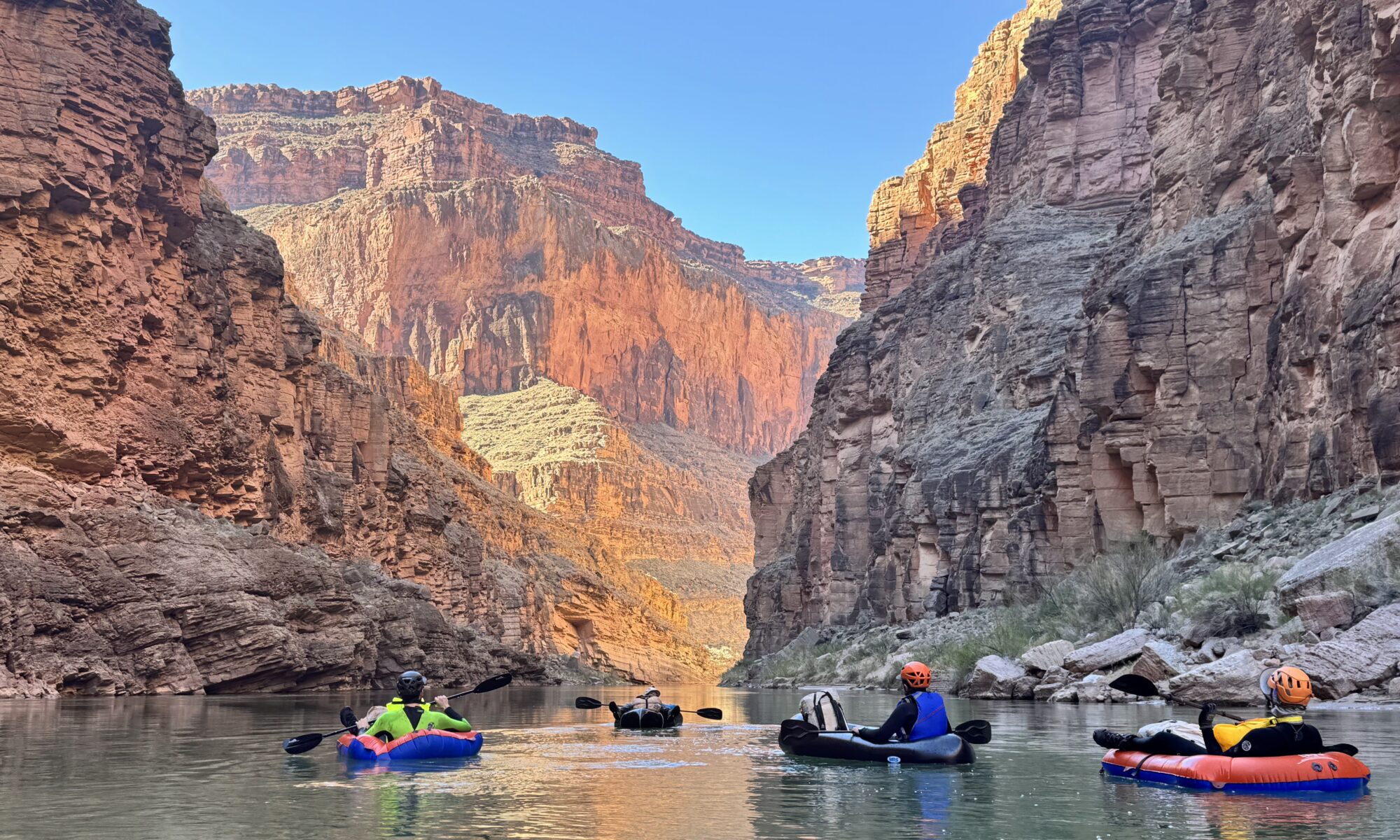
We are taught that healing is a climb—a steady, upward trajectory toward a summit called “Perfect Health.” We think that if we just pack the right gear, follow the strict protocols, and exert enough willpower, we’ll eventually reach the peak and stay there.
But that’s generally not how the body works, especially when it comes to navigating chronic illness or injury, or just run-of-the-mill aging. We encounter false summits. We hit valleys we didn’t see on the map.
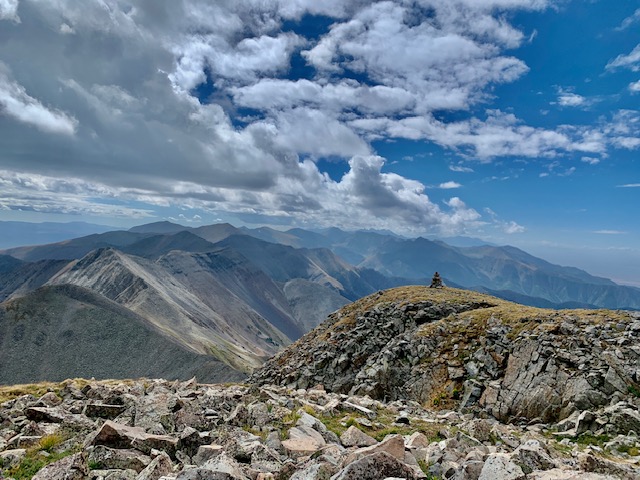
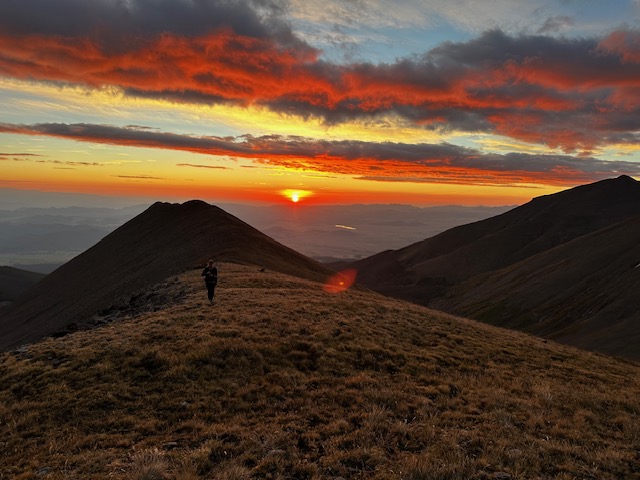
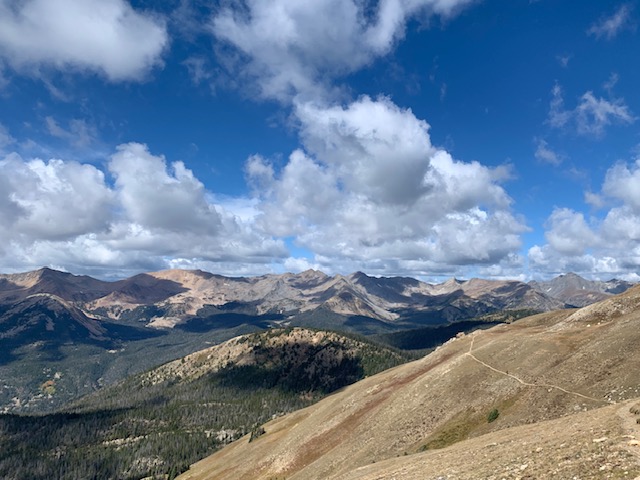
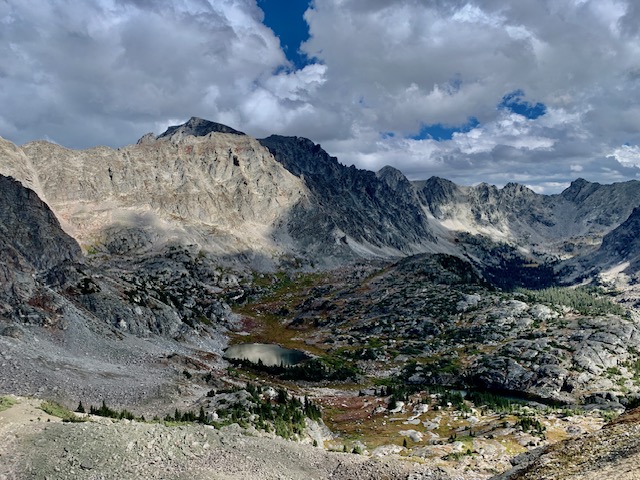
Last September, on a 13,000-foot ridge in the Sangre de Cristo mountains, I hit one of those valleys. And it resurfaced a question that’s hit me before when my body has failed to “perform”: who am I, and what value do I have, when my endurance and strength are gone?
It was the last Saturday in September. I’d just returned from my final guiding assignment of the season, Yellowstone, on Wednesday. I was so excited to be back home with Troy; excited to get out for long days in the mountains as we love to do. Colorado was having an exceptionally beautiful display of autumn colors and I was relieved I’d made it home in time to enjoy it.
We’d planned on Pyramid Peak, one of the Sangres 13ers we hadn’t completed yet. At 5300’ of vertical gain, it’d be a challenge as I hadn’t completed a day like that in about a month, but I’d been backpacking daily during that time so it didn’t feel like too much of a stretch.
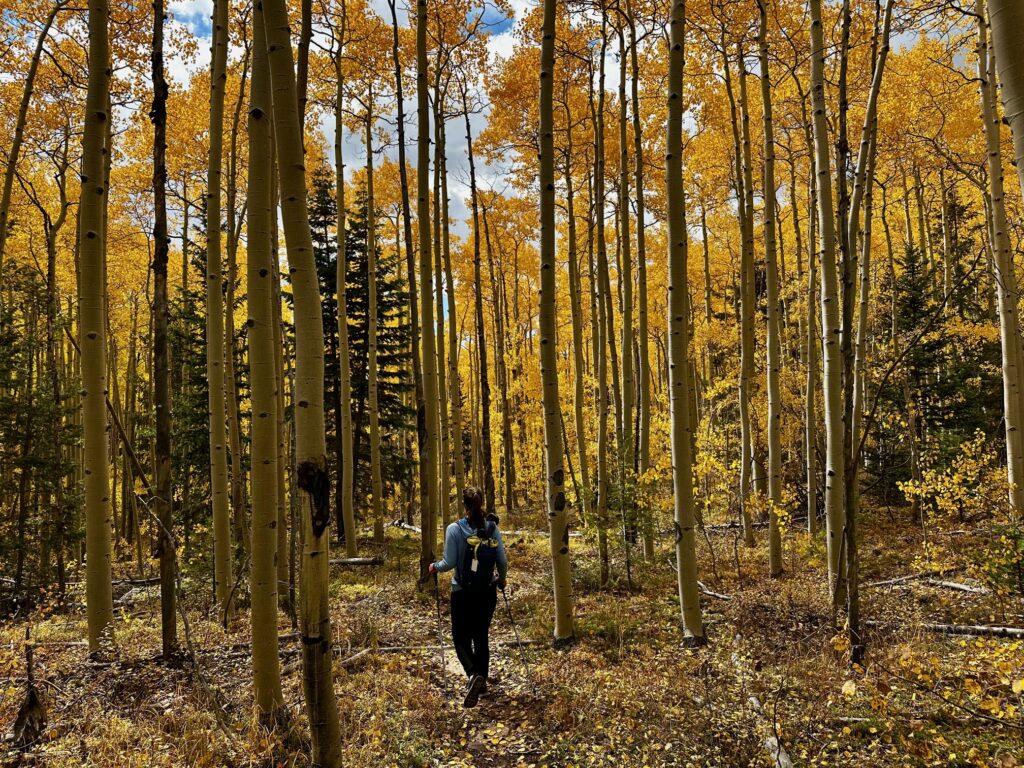
The day started beautifully: a cool, crisp trail winding along a creek through the changing aspens down low. Near the 10,000’ topo line, we veered off trail and started ascending more steeply towards the summit, still 3000’+ of climbing away. Trudging up towards the treeline on a 40-degree slope, my legs turned to lead and my heart hammered in my chest. Just keep going, you’ve got this, I encouraged myself, trying to stay positive.
Troy was pulling away ahead of me. He reached a shoulder and waited for me to catch up. “Everything okay?” “I feel awful,” I blurted out, “Empty.” “Do you want to take a break?” “I’m fine” my Pride responded. He shrugged and we pushed on. Again, he pulled away. Wallowing in my frustration and self pity, I dragged my limbs up the slope, stumbling over rocks and my own resentment. Today was supposed to be fun. My first day back at home, in the mountains with Troy. Why am I so utterly drained?
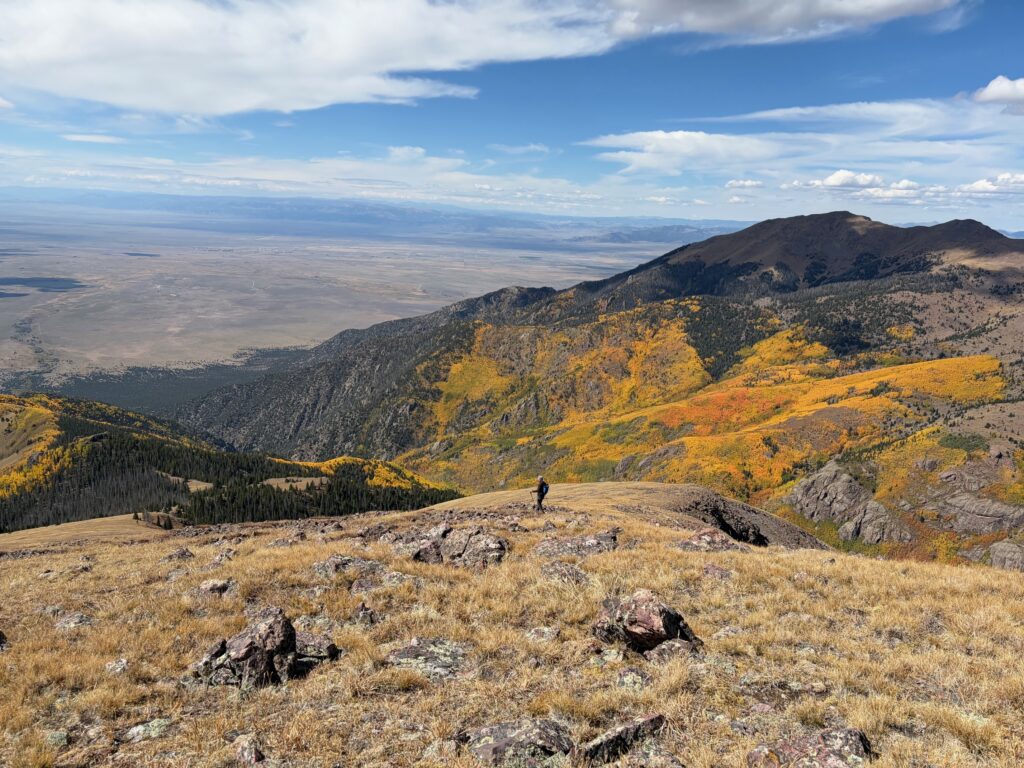
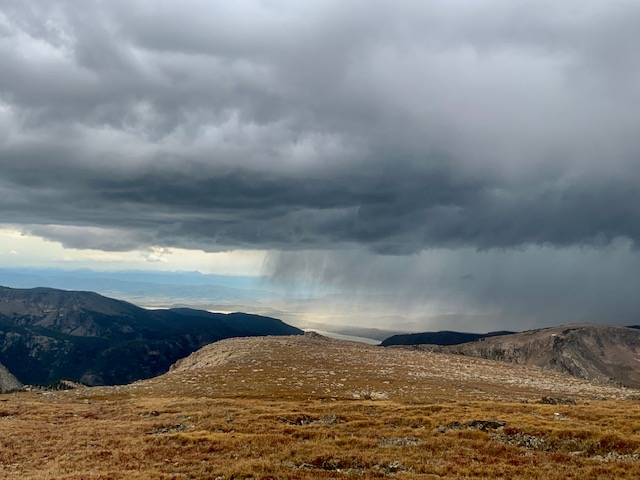
Troy waited, and again I slowly caught up. “Are you sure you don’t want a break?” “Fine,” I replied dejectedly. I didn’t want to take a break, but I needed to. I slumped down in the tundra and stared blankly into the San Luis Valley, a beige mirage thousands of feet below. I didn’t want to be grumpy. I didn’t want to take my frustration out on him. I wanted my body to cooperate. I wanted to feel strong. That was me; not these heavy legs, this lack of energy. I should be able to do this. My mind shuffled through a rolodex of mental snapshots. Moments when I felt strong, powerful, virtually limitless in the mountains. Why am I struggling so much?
My mind began the familiar mental inventory of all the things I could have or should have done differently that might have affected my physical performance that day: maybe I’ve been eating too much dairy, or not enough antioxidants; maybe it’s because I haven’t been taking my supplements all summer; maybe I had too much caffeine this morning; maybe I had too much blue light exposure before bed… and on and on. Dissecting every minutiae of the day to figure out how to fix the problem (my body).
Beneath the frustration of this outing, and the true root of my foul mood, was the fear that I was right back where I was last winter (and where I’d been many times before), in the worst autoimmune flare I’ve ever experienced, unable to ski uphill more than a few thousand feet without being so fatigued I needed to go home; unable to ski downhill even a lap or two without my muscles aching. Feeling victimized, angry. It was the fear that I was back where I was in 2014, post-PCT, when I couldn’t even run a few miles without my muscles burning, even though I’d just hiked 2600+ miles. Why won’t my body just cooperate? This repeated scenario rattled the deepest part of me: my identity; my life-long self concept as “strong and capable.” If I wasn’t that, who was I? What value did I have?
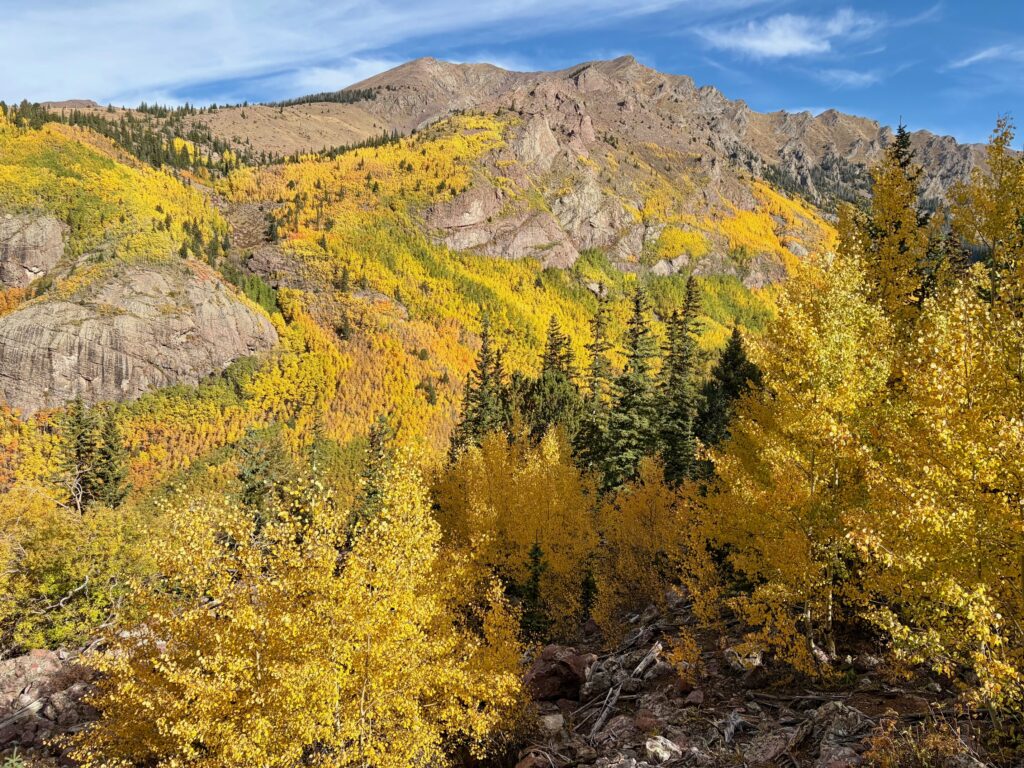
Troy tried to comfort me, offering me snacks and kind words. “We can turn around here. It’s no big deal. And look how beautiful it is.” I looked up, actually seeing what was around me for the first time since starting the off trail ascent. Aspen trees covered the hillsides and ridges in every direction. Their leaves glittering orange, red, and gold in the autumn afternoon light. I was so stuck in my head, in my frustration, that I hadn’t even noticed. Here I was, in one of my favorite places, at the most perfect time of year, with the person I loved most, not enjoying a single moment of it.
The Health Hustle Rabbit Hole
I thought about the whole arc of my health journey from the desperation to control to the eventual surrender to my body’s cycles. It’s been a decade since I found out about the Hashimoto’s, an autoimmune thyroid condition. The crushing fatigue, the inexplicable weight gain, the cold hands, the hair falling out, the inability to effortlessly run for hours in the forest as I had before. That’s when I first felt the frantic desire to “figure it out,” to “fix” my body, ashamed that I could no longer “perform” in the mountain.
After bloodwork confirmed my thyroid and adrenals were dysregulated, I went down the rabbit hole, spending hours on PubMed reading research articles, pouring through books, consuming dozens of hours of information from medical experts. I was willing to try anything and everything to get my body back to normal. I eliminated any food I may have an intolerance to. I ordered hundreds of dollars worth of supplements and blood tests. I said “No” to dinners with friends, unsure if there would be anything I could eat. I avoided hiking with others, not wanting to slow them down if I was having a “bad” stamina day.
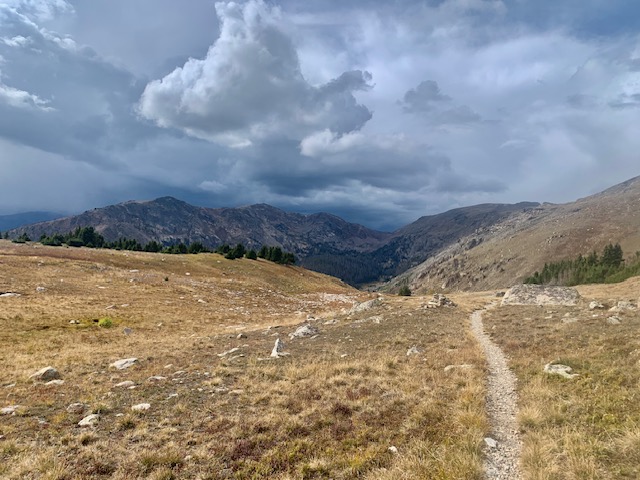
The nutrition, sleep, and supplement protocols I implemented were largely successful, but the path wasn’t linear; it looked like a topographical map of a mountain range—peak, valley, peak, valley. Improvement, setback, improvement. I thought I’d get better and stay better, but it was more complicated than that.
Despite massive leaps forward, this time was also marked by desperation, grasping to attain and maintain the health of the capable outdoors person I knew myself to be. Every 6-12 months when I would get my bloodwork done, I’d be anxious to see the result, knowing it had the power to alter my mood for days. It might look great, or it might send me into a tailspin of What did I do wrong? What else do I need to change? Why can’t I figure this out? I need to try harder, control more. I’d wrack my brain, trying to make sense of things. Maybe I accidentally ate gluten. Maybe it’s that I’m spending too much time in front of screens or not enough time outside. Maybe I need to cut out nightshades. Maybe it’s mold, or a hidden virus.
Eventually I hit a breaking point. The health hustle was too much. Exasperated and confused during a particular low point, I asked myself, “Even if I never figure this out and my body never gets better and I’m never able to do what I used to be able to do, can I be okay with that? Can I find a way to enjoy the outdoors and be okay with myself?” I had to let myself think through this worst-case scenario and decide that, “Yes, I could be okay with that.” Facing that allowed me to begin to break free of the pursuit of perfect health.
At this point, I’d been through enough cycles of progress and setback to understand the ways in which my pursuit of health had become its own prison. It was costing me time, money, connection, and, above all, peace of mind. I came to terms with the fact that sometimes, despite doing everything “right,” the body operates on its own timeline.
The Stress Epiphany
Back on the tundra choking down a dry peanut butter sandwich between sobs, Troy attempted to console me. “You’ve had a really busy summer. Your body just needs some rest. This doesn’t mean anything about you or your capabilities. We both know you can still kick my ass up this mountain. And even if you couldn’t, that doesn’t mean anything about how amazing you are and how much I love you.”
He said to me the things I needed to be saying to myself. I reflected on the busyness of the preceding six months. Since late April, I’d spent 70 days in the field guiding (not including travel), across four different locations, and also squeezed in a 14-day walk across Iceland. And then there was the persistent underlying stress of my mom’s declining health always in the back of my mind, along with several smaller “death by a thousand cuts” type incidents, such as losing my phone in a stream midway through my Yellowstone guiding assignment.
As I sat there, I realized this wasn’t just a bad day; it’s a pattern that started in 2014 and which has revisited me at various times and with varying degrees of intensity since: most of my “health crashes/autoimmune flares” root back to stress. I thought back to the previous winter, one of the worst “flares” I’d had in decades. It started with a cold from which my body never fully recovered and which snowballed into a season of struggle.
A journal entry from that time:
“I’ve been in a cocoon this winter. My former self melting into a puddle, unclear what forms it’s to take next, unknown transformations happening beneath the surface. It’s been painful and confusing. I’d like to be skiing this morning, but my body will not allow it today, so I guess this is the day I finally sit down to write up this post that has been on my mind for months. The intention of sharing it on the blog is to be a resource for others who deal with Hashimoto’s disease and the flare ups, or anyone who’s familiar with the non linear healing journey, or anyone whose self concept is one of ‘strength, endurance, doer of hard mountain things’ and they find their body uncooperative in the pursuit of their identity-defining features. Alchemizing this shitty thing into something useful.
Since about mid-November (2024), or at least since Thanksgiving, I’ve not been doing well. In addition to getting sick, I was immediately plunged into a heavy workload. My resting heart rate was through the roof (for me); similarly my heart rate variability in the low-30s had rock-bottomed (for me). On the days I went out to ski uphill at Monarch with Troy, I was exhausted, dragging ass up the hill; a far cry from my normal endurance base. When I skied down, my leg muscles searing so bad that I had to stop multiple times on a short run to keep from collapsing. I’m frustrated and disheartened by my fatigue, my inability. This time has not only been extremely challenging on a personal level but extremely hard on my relationship with Troy as well.”
Gazing out across the valley, I thought about how I am an expert at the ‘I’m fine’ lie, ignoring quiet signals until they became screams. I tell myself, and I truly want to believe, that stressors aren’t affecting me, but the body doesn’t lie. This denial leads to overextending myself emotionally, mentally, and/or physically.
And much to my dismay, there’s no quick fix for creating a true and lasting sense of nervous system safety. You actually have to do the hardest work of all: listening to your body and slowing down. Choosing to rest, or turn back, when your ego wants to push through. It’s easier to try to supplement your way out when what’s really being asked is to address what’s not working in your life and what your body is actually asking for (e.g. rest).
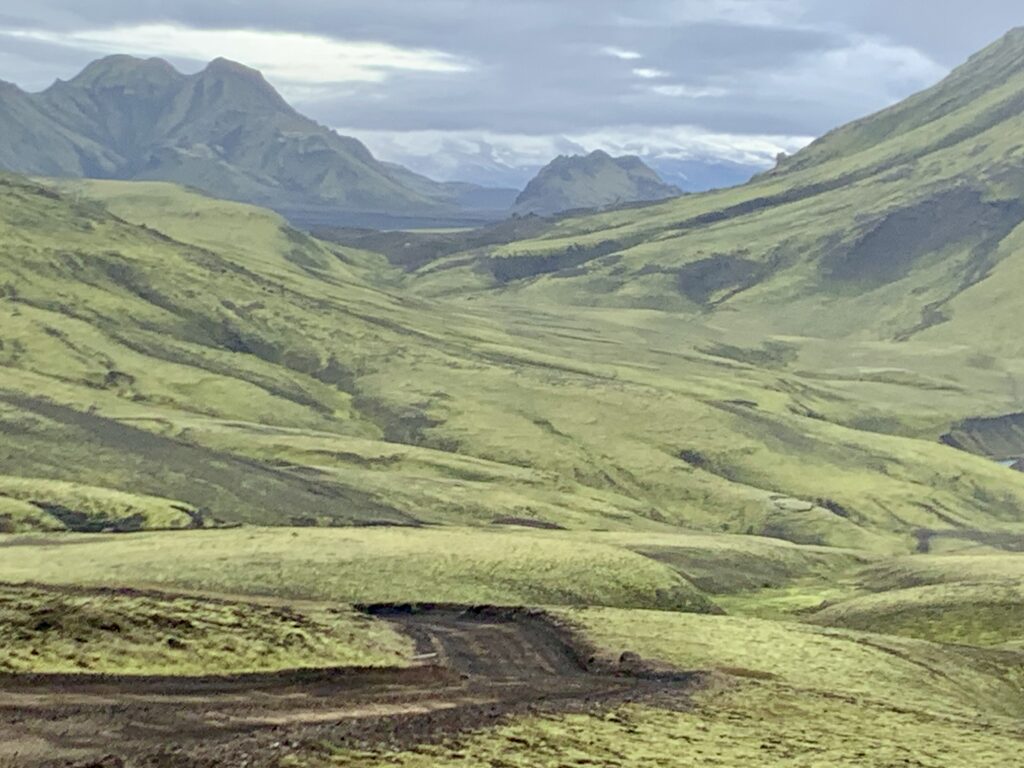
I tried to internalize Troy’s reminder: even if you aren’t the strongest, you’re still valuable. While I rationally know this to be true, it’s taken years of reprogramming to actually believe it and embody it. Whether it’s Hashimoto’s, aging, or injury, we all eventually face this gap between who we think we are and what we can physically do. How we respond to that gap – whether we choose to fight it, deny it, or come to peace with it – shapes how we move forward.
“Should we head down and head to the hot springs?” Troy asked. Internally I protested for a moment, wanting to say “Let’s keep going. I can do it.” I exhaled deeply, a weight lifting off my chest, “Let’s stay a bit longer and enjoy the trees, then we can head back. I’m bummed but I guess the summit will be here for another time.”
As I soaked in the hot water, staring up at the golden ridgeline we’d just come from, I considered this winding journey I’ve had with adapting to these health complications that have affected my sense of my endurance, strength, identity, and ultimately, value.
Throughout this 12-year journey, there are a lot of practical tools I’ve learned that have helped me to recover faster, hike longer, and generally enjoy my time in the outdoors more. I’ll cover those in Part II. But it’s using these tools in conjunction with the right mindset that make navigating inevitable body changes a source of resilience and wisdom rather than frustration and desperation.
The Mindset Lessons
If you find yourself on your own version of that tundra, here is what I’ve learned to be most impactful in navigating this path:
Redefine success. A good day in the mountains no longer has to include a summit, big miles, pushing through, or feeling strong. Similarly, the destination with the “health tools” I employ isn’t glowing health. Time well-spent outside includes presence and appreciation for nature; listening to my body and honoring my needs. It’s about enjoying time with people I like, eating good snacks, drinking from creeks, soaking in the sun, and generally reveling in the gift of being in this body while I can. “Success” is doing what I can to support my body’s health as much as possible but not beating myself up if I can’t climb or hike as hard as I used to; it’s being able to still enjoy the outdoors no matter the state of my body.
No comparison allowed. The only person whose experience I can fully understand is my own. It’s a waste of mental energy to feel self-pity because I’m dealing with a certain set of circumstances that others aren’t. Or envy that another person seems to be having an easier time moving through the mountains than me. The “no comparison” rule also applies to comparing myself to past versions of myself. I’m in the body that I’m in now and that’s all that actually matters.
Come back to gratitude. Always a powerful tool for shifting perspective. It’s only in hindsight that I could see how much I took my functional body for granted. Instead of sadness for what my body can’t do, how about appreciation for what it can do? Or even gratitude that I have a body at all.
Remember why I love being outside. Instead of a stage on which I perform athletic feats, it’s a place to feel grounded, clear, and free; to reconnect with myself; to shake off the mundanity and distraction of modern life; to be part of nature; and to have fun and play.
Accept what is. This is the recognition that, like nature, the body has cycles. It’s naïve and immature to expect the body to only get stronger when the biological reality is that we’re all on a slow, steady march towards death. This doesn’t mean that we don’t continue to push ourselves to do hard things or to take care of ourselves as well as we can. We do, but with more wisdom, grace, and inner attunement. We learn how to be adaptable and responsive to what’s present versus what we planned. It’s a more honest relationship with ourselves and with life.
While I know that it’s these mindset tactics that will help me navigate the next health valley with more composure, trust, and wisdom, there are specific tools I’ve used to support my body and pull out of each slump faster, including this most recent one in autumn of 2025. In Part II, I’ll share the specific nutrition, sleep, and supplement protocols that help me manage my Hashimoto’s and stay in the mountains.
I lean into the wind—a solid, invisible wall—forcing my body forward, toward the valley head. It takes the full weight of my body just to maintain balance. Next to me, I see Troy’s silhouette fighting the same impossible force, bracing against the whipping dust. The sky is gone, replaced by a churning, opaque fog of beige dust. Every inch of me is covered, yet the sand finds a way in. Beneath my buff, grit scours my teeth, and my eyes, burning behind sunglasses, water incessantly. All I hear is the constant rattle of thousands of grains of dust blasting the hood of my jacket. Two questions swirl in my head: What am I doing here? Why did I feel drawn to come here?
But we’re getting ahead of ourselves. Let’s start from the beginning.
Route Overview & Intentions for Going
Iceland had been on my radar as a backpacking destination for a long while, and being on the cusp of my 40th birthday, I decided this year was the year to make it happen. I was drawn to the natural beauty, of course. I also wanted to experience what makes the culture and people unique, and to enjoy a multi-week backcountry trip with Troy. At least these were the logical-sounding reasons that I told myself and others when they asked.
To be honest though, I wasn’t sure exactly why I was going. I just knew that it was a destination that kept surfacing in my mind, and I was confident that at the end of the day, if I was spending two weeks moving through nature, wherever I was, it’d likely be worth it.
So, I set to planning and in August of 2025, Troy and I spent two weeks walking across Iceland, an island of rough, volcanic extremes that’s nestled in the North Atlantic a few degrees south of the Arctic Circle. It has a subpolar oceanic climate that creates famously unpredictable weather, with strong winds and frequent rain being common year-round. Our route covered roughly 340 miles and consisted of cross country travel, rugged 4×4 roads, and maintained trails. Walking surfaces included sand, volcanic rock, dirt, gravel, moss and grass.
It’s a desirable destination for many reasons, not the least of which is the unparalleled natural beauty. Known as the land of ice and fire, the landscape is shaped by ongoing volcanic, tectonic, and glacial activity. Traveling across the country meant an immersive tour of the powerful forces of ice and fire: massive glacially-fed rivers, expansive ice caps, and a variety of geothermal features including volcanoes, fumaroles, boiling mud pots, lake-filled craters, steaming rivers, and black sand beaches.
That wind would be our faithful companion throughout the journey, driving us mad in one moment and offering an opportunity to practice ultimate surrender the next; our response dictated by our current moods and capacity for discomfort. Of course, I’d known this was likely to be the case when I started my trip research eight months prior. But it’s always hard to imagine exactly how challenging something might be from the comfort of your desk, well-fed, in a temperature-controlled room. From there, the idea of hiking across Iceland sounded great.
Iceland day-by-day
Húsavík to Reykjahlíð
Shortly after 1pm on a drizzly gray afternoon, we set out east from Husavik, a town of about 2,500 inhabitants best known for its incredible whale watching. True to our natures, like we’re heading out for a walk up our local Tenderfoot Hill, we set off in silence. No fanfare, just walking.
While creating our route in the months prior, we quickly found that the options for crossing the island are many. Ultimately, our decision to start from Husaik, rather than the northernmost lighthouse of Hraunhafnartangi, was a logistical one. There’s no longer public transport to the lighthouse and our schedules didn’t allow for us to spend an unknown amount of time waiting for a hitch. Walking out of town was easiest and most efficient.
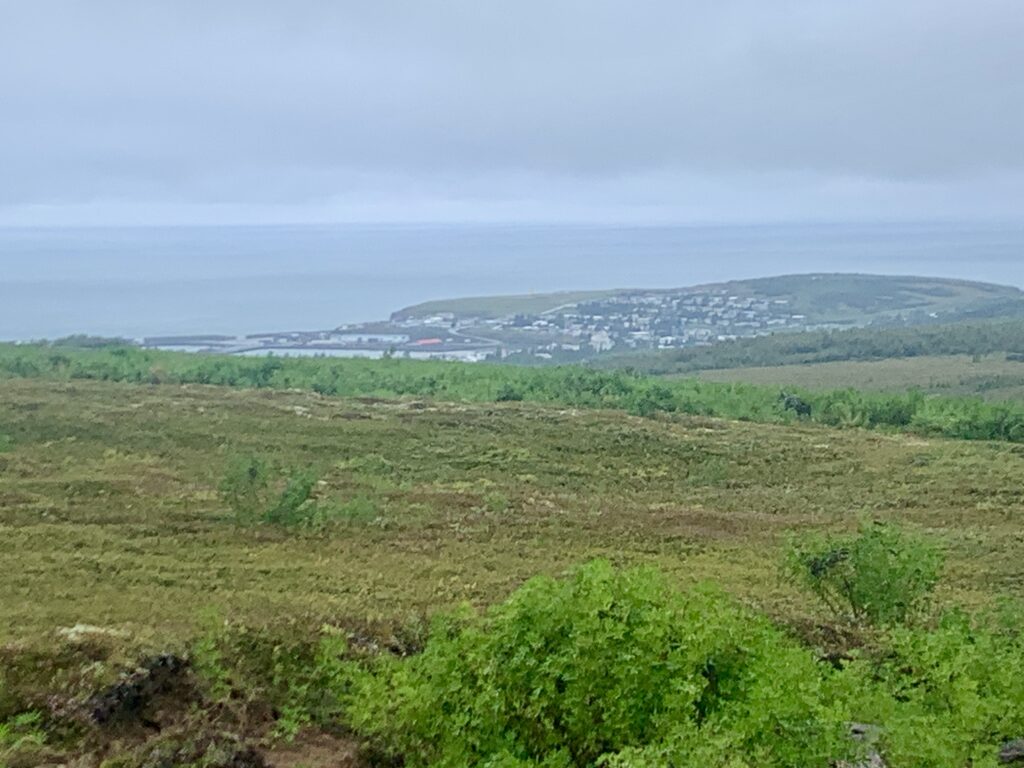
Loaded with 12 days of food, the shoulder straps of my pack dig into my shoulders and cause my iliac crest to go numb, but I barely notice as I’m so delighted to finally be walking after nearly 48 hours of travel and final preparations. Birch trees and lupine blooms line the path drawing me towards the first of hundreds of lakes to come. Half a dozen gulls dot the surface. As we climb above the shrubbery, I look back over my shoulder to see the town nestled into a small bay. Beyond is the ocean, an endless expanse of aqua blue beneath a low gray cloud. After months of planning and ironing out details, it’s liberating to finally be executing the plan. Nothing more to do except walk now.
The remainder of the afternoon is a blur, time muddled as we hike alongside a road, in a cloud. Fortunately, traffic is sparse and the miles go quickly. Road walking is never my preference, but as I gaze up at our off-trail high route option encased in cold rain and wind, I’m grateful to be down low. It’s day one and already I’ve worn all the layers I’m carrying. I feel justified for throwing in the extra mid layer and heavier rain gear.
Around 7pm, we find a protected spot behind a knoll to set up camp in a clearing of dwarf birch. I’m satisfied to have put in a solid day of walking despite our late start. We get a hot meal in us and, still jet-lagged, fall into a deep sleep soon afterwards.
The storm clears overnight and we awake to clear skies and sun. Our spirits are high and we pass the morning walking dirt paths eastward towards Vatnajökull national park. The old farmer’s roads are the most efficient walking here as they create a navigable route through a landscape full of deep fissures and mounds of lava rock that are covered in a dense layer of dwarf birth, crowberry, lichen, and moss.
The only life to break the volcanic stillness are the domesticated sheep. They roam the land and bring me joy. We unintentionally startle them from their burrows beneath overhung shrubbery, surprising both them and us. Baaaaaing, they scurry up the road and then we repeat the whole thing thirty minutes later when we come across them again. And again and again.
As we walk, I’m pleased to find that there’s a wider diversity of shrubs and wildflowers than I anticipated. Some are new to me and others are familiar friends. It’s humid this morning and when the breeze subsides, the midges are upon us in droves; dive-bombing our eyes, buzzing in our ears, and trying to fly down our throats. Losing patience, we don our headnets and continue on, hoping for a light wind.
By early afternoon, we’re at the park, ready for a break. After topping off with water from the surprisingly nice WC, we sit at a picnic table(!) for a relaxing lunch in the sun. We’ve put in 20 miles, but the day is still young and we’re excited for what’s next. We press on, knowing that camping is only allowed in designated sites within the park, and our next chance will be in 12 miles.
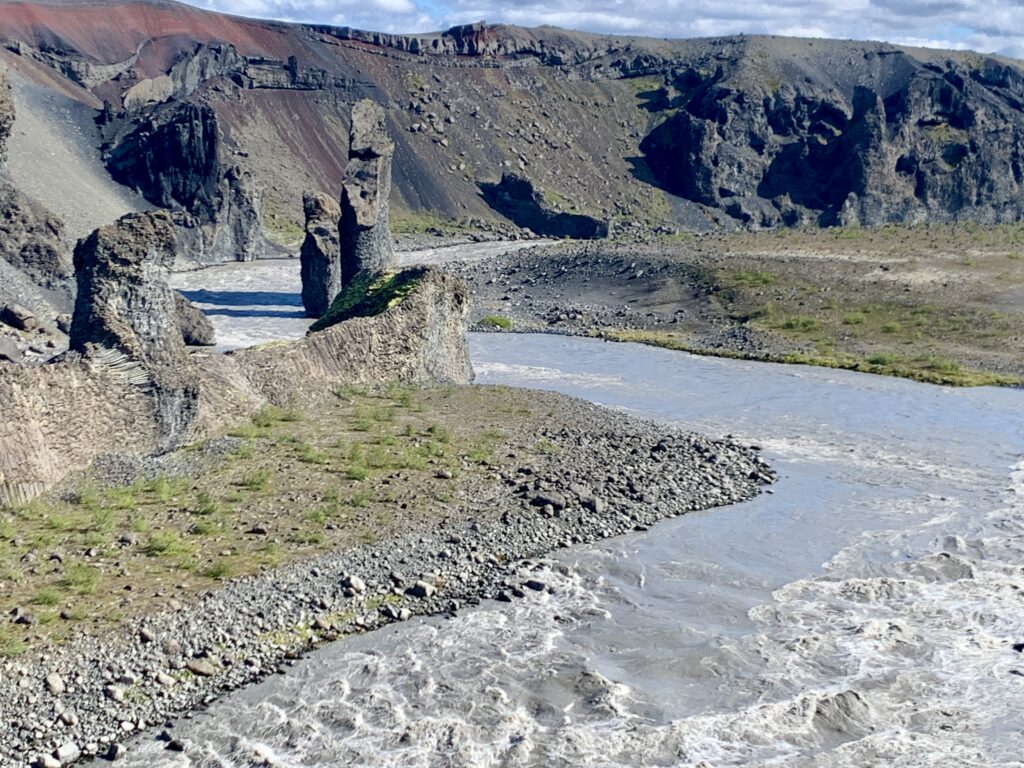
The sound of a roaring river beckons us to the edge of a gaping canyon. A hundred feet below, we see a wide, rushing, milky torrent making its way to the sea. Jökulsá is the second longest river in Iceland. Its source is the Vatnajökull glacier, which we will spend the next seven days walking towards. The canyon, we learn, was carved 8,000 years ago from a lava blockage in the water course which caused catastrophic flooding. Its walls consist of ornate columnar volcanic rock, indicating that the lava cooled slowly.
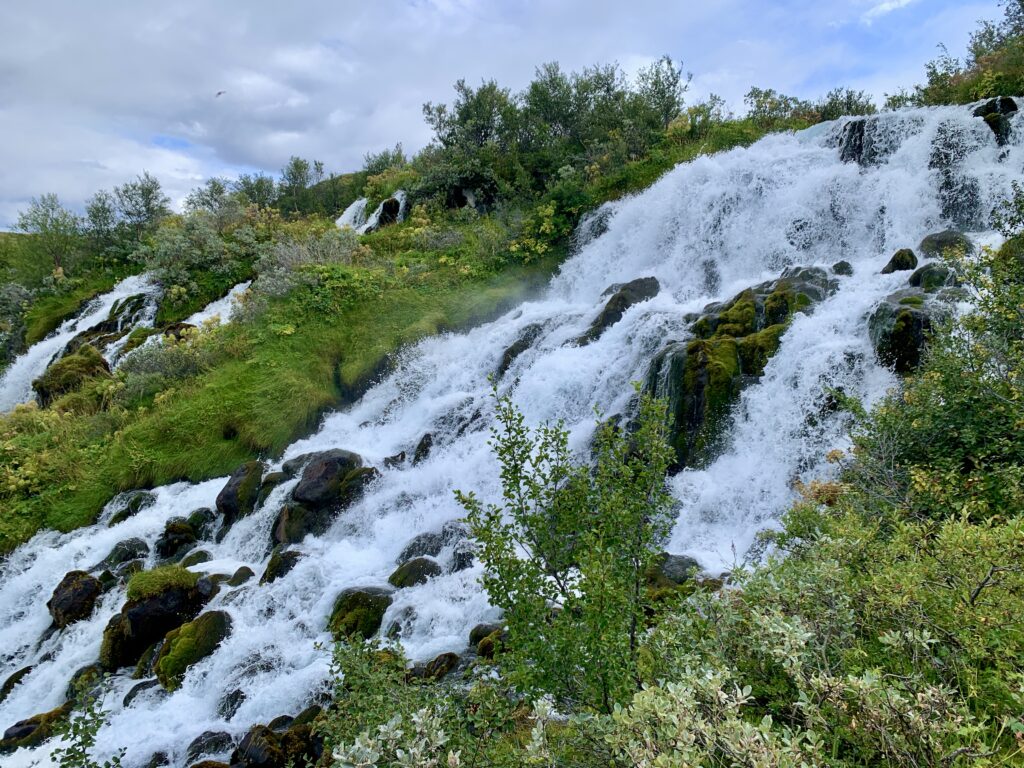
Enlivened by the change in scenery, we dip in and out of treed patches, admiring the river below and the plethora of little waterfalls gushing from the canyon walls. As the miles stretch on, our bodies feel the impact of the miles on our feet coupled with the weight of our packs. Breaks become more frequent and our pace slows. After what feels like a long afternoon, shadows already long and air cool, we close in on Dettifoss. We’re pleased to find camp in a circle of large, wind-protected boulders. We’re even more pleased that the park has cached water here for hikers, saving us a trip to find it. Bodies aching, we’re grateful to be done for the day.
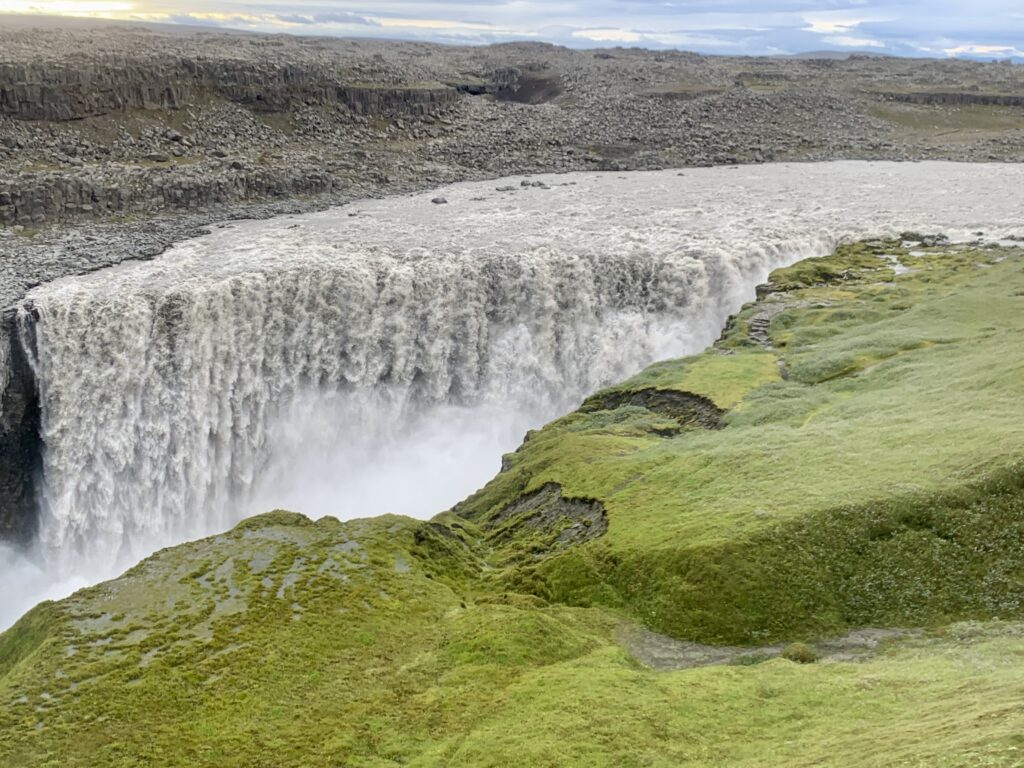
I wake up refreshed and with childlike excitement for the day ahead. “Today we see Dettifoss,” I whisper to Troy. Dettifoss is one of the most powerful waterfalls in Europe and a landmark I’d been looking forward to since I started planning. The sky is grey today and there’s a cool breeze, but it doesn’t feel like there’s precip coming. I sling my pack on and notice it finally feels just a tiny bit lighter; a good feeling. After an obligatory visit to the heated park bathrooms (very nice!), we follow a short path to the canyon’s edge.
Being early, we have the rare treat of experiencing this famous feature with no one else around. Thousands of gallons of water plummet over the cliff, vanishing into the churning, self-created spray and roar below. Along the banks, thick carpets of vibrant moss peppered with tiny white flowers blanket the ground. Exposed soil indicates where whole slabs of peat have slid into the abyss.
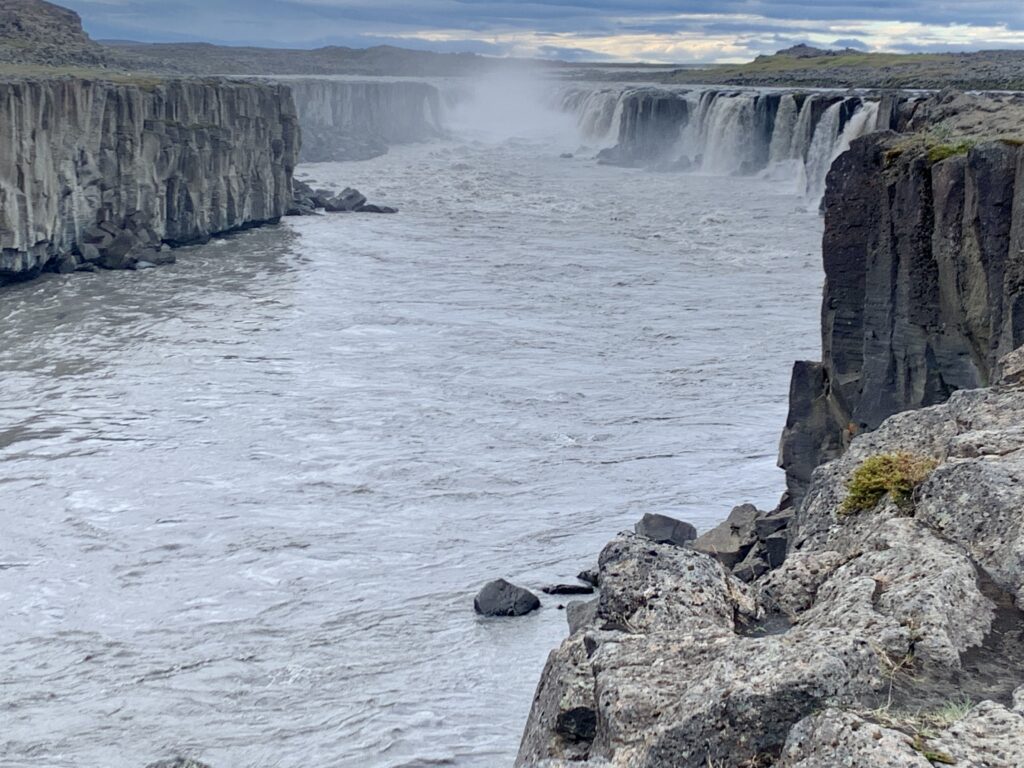
Droplets from the spray cloud gather on our coats and the thunder of the water is so loud that we have to raise our voices to speak. So we don’t speak much and instead admire the powerful scene in silence. Like the jumping flames of a fire, it’s mesmerizing and I could watch for hours, but we’ve got places to go. Before heading off into the moonscape toward distant peaks, we walk upriver to Sellfoss, a smaller, though still extremely impressive, waterfall.
Heading west, the gravely ground provides fast, firm travel. We drop over a rise into a rolling heather-willow-dwarf birch valley. Hints of crimson ground cover and yellow willow leaves draw my attention. It’s early August and fall is already here. I spot four fuzzy mounds — more sheep! I’m amazed by how the sheep can live here in the harsh conditions, with seemingly little water.
We’re aiming towards a mapped hut, hoping it will provide a cozy spot for lunch. What we find is a dilapidated, mouse-infested shack. We sit behind the building for a break from the wind. Clouds build over the afternoon as we make our way towards Krafla, one of Iceland’s most active volcanoes. Sprinkles begin and soon it’s a full on downpour. I’m warm enough, as long as we keep moving.
Sheets of rain over the moonscape feel ethereal, other-worldly. Pushing forward into the drizzle, engaged by the navigation and scenery, I look up to find that we’ve entered a valley bordered by ochre cliffs. The rain has ceased and it smells of sulfur. Reindeer and snow lichen cover the ground, reminding me of the Brooks Range. Silently, a Golden Plover takes flight from behind a rock. We crest a small pass, collect water from a stream, and make camp on the leeward side of a knoll.
Wind howls and rain pelts the tent throughout the night. When it’s time to get up, it’s cold, blustery, and misty. I very much do not want to get out of my quilt and start walking in the windy drizzle. But, we need to keep moving and also, today is the day we get to Reykjahlíð, a small village where we can get a good meal and top off our food supply. We don rain suits and get going.
Iceland’s geothermal activity is driven by a hotspot that sits atop the Mid-Atlantic Ridge, which roughly splits the country in two along a north-south axis. The Ridge forms the divergent boundary between the North American and Eurasian Plates and along it are many of Iceland’s most active volcanoes.
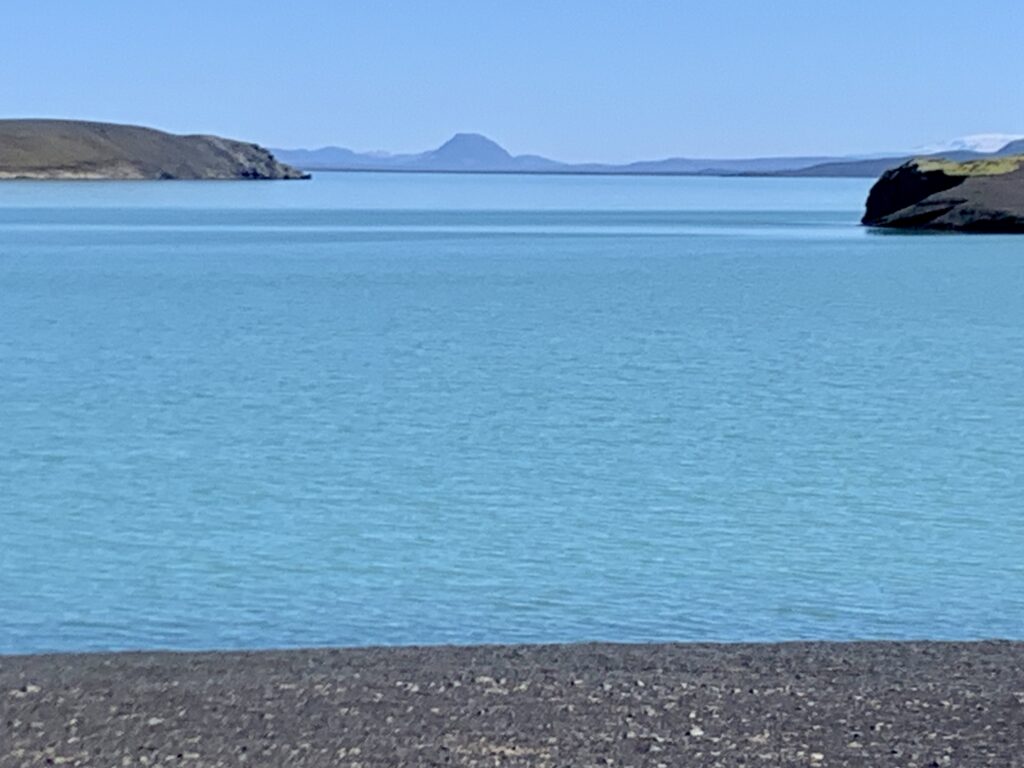
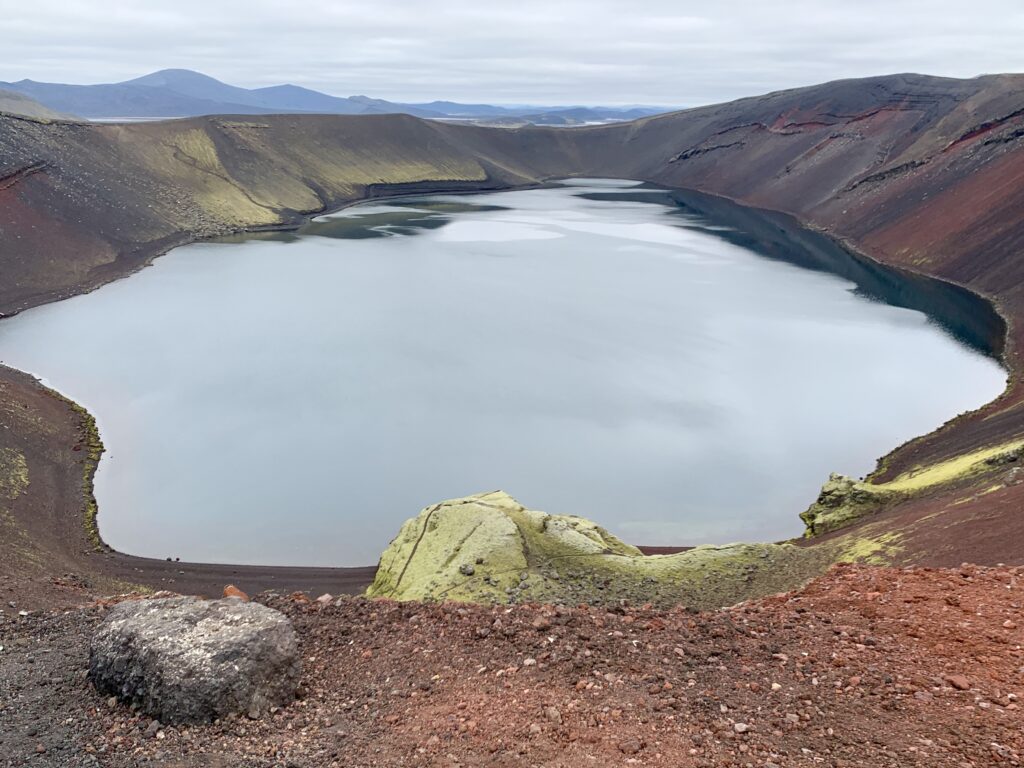
This morning, we’re hiking over the shoulder of one of these volcanoes, Krafla, which last erupted in 1984. Viti, Krafla’s crater, is about 1,000 feet in diameter and 150 feet deep, and contains a striking blue-green lake. At the crater’s edge, we stand in the rain gazing down into the aquamarine pool. Beyond the crater rises billowing steam from the Krafla Geothermal Station, which drives two large turbines.
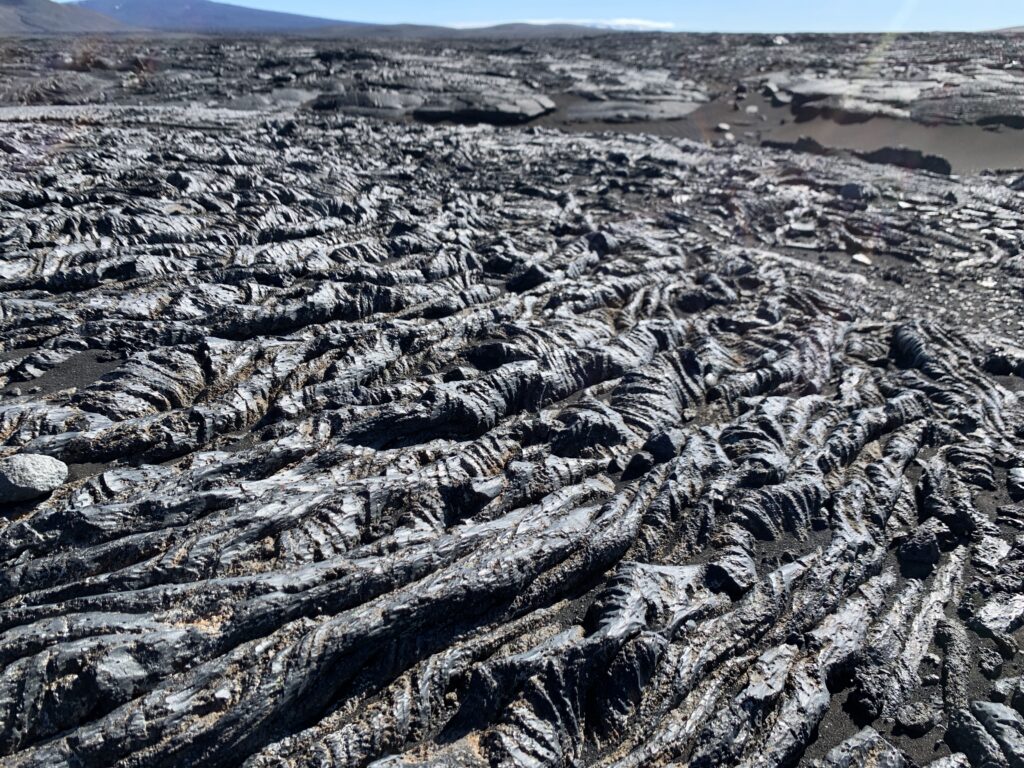
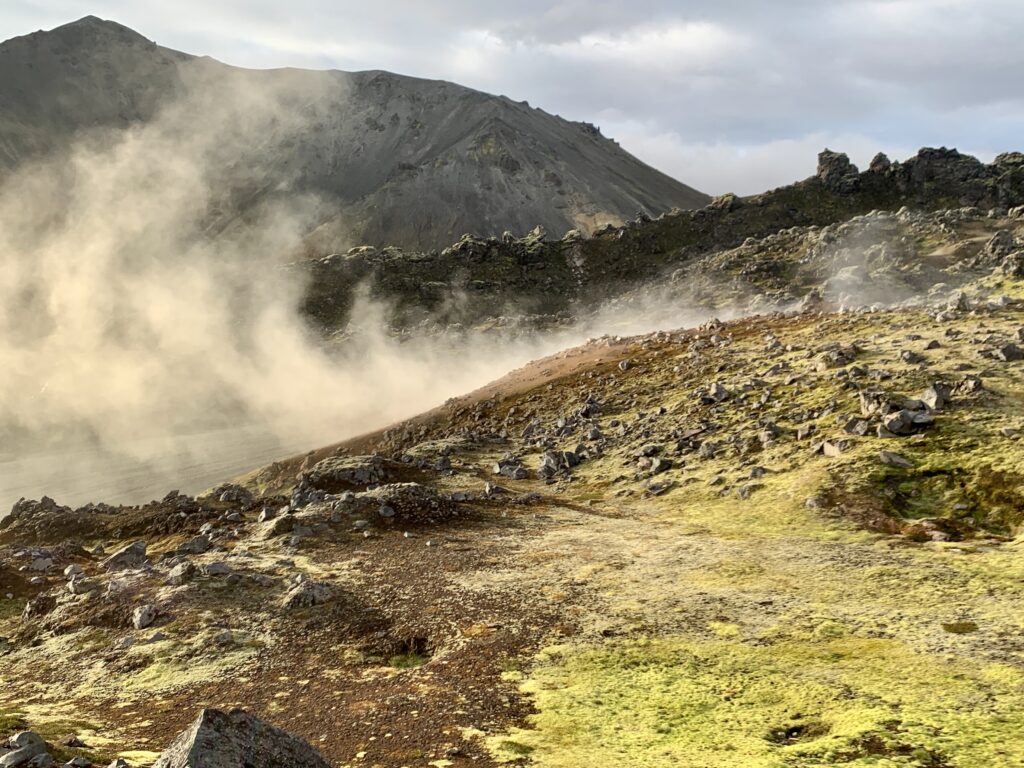
Departing Viti, we enter an extensive lava field that will take us the remainder of the way to town. Thankfully there’s a path as it’d be nearly impossible to navigate our way through the mangled landscape otherwise. Even with the path, it’s tough walking across sharp, rolling ridges of pumice. Fumaroles spout steam from russet hillsides. I’m making connections between what I saw on satellite imagery months ago with what it’s like to actually walk here.
By mid-morning we’re in Reykjahlíð, setting up camp with front row views of the massive Lake Mývatn. We enjoy the amenities including a hot shower, covered cooking tent, indoor bathrooms, WiFi, and outlets. The small village has everything we need, including a couple of restaurants and a small grocery to top off our supplies. Chores complete, we focus on resting. Our next stop is Landmannalaugar in eight days.
I drift off thinking how good it feels to finally be getting into the rhythm of the hike. There’s a liberating simplicity in knowing that our daily life for the next ten days is walking, eating, and observing. Just be present to the experience and the surrounding landscape. I hope that we stay healthy and that the Icelandic weather is kind to us, or at least not too punishing.
Reykjahlíð to Landmannalaugar
I’m grateful for a refreshing stay and ready to move on. In the morning mist, we trace the eastern edge of Myvatn heading southbound. Mist becomes a light drizzle. At least it’s relatively warm and not windy. The landscape is lagoon-like with little lakes, grassy pumice islands, and ducks sitting peacefully atop still water.
With the straightforward navigation of this section, there’s plenty of time to let one’s mind wander. I think about how much trail and road walking we have on this route and question my decision to come here, knowing my love for the engaging nature of an off-trail route. But, there’s something that this type of walking offers that off-trail hiking does not: space for your mind to relax and go where it needs to go, thoughts untangling with each footstep forward.
I think about how this trip is a 40th birthday present to myself. I think about how I’m grateful that my body can still put down high mileage days. I think about the length of a life, about the passage of time, about my dad’s death and my mom’s health.
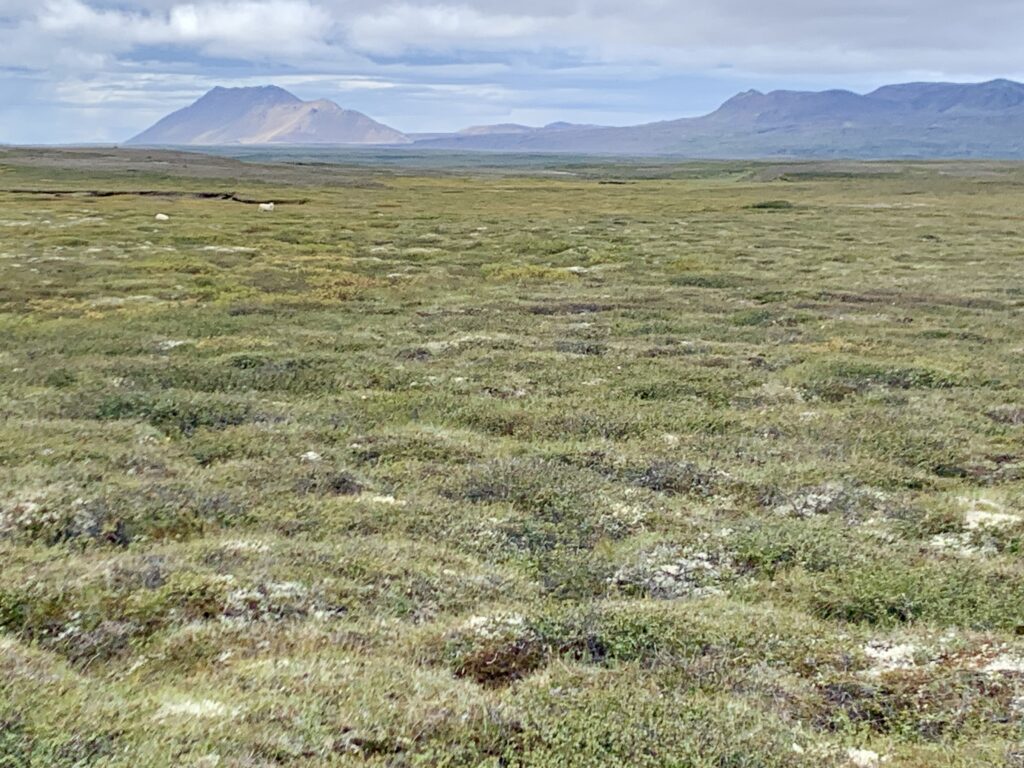
After nine miles of misty, midgy shoreline walking, we break off to the south, entering pastoral sheep land. Grass fades to broken rocks and soon we’re back on the moonscape walking towards Sellandafjall, a large mountain on the horizon. With no trees to provide scale, it’s hard to gauge distance here. We walk towards it for hours. We break, we lunch, we talk, and we walk in our own thoughts.
I remember on the Oregon Desert Trail walking towards a lone tree on the horizon for much of the day, miles upon miles of the same sage-specked landscape flowing by. Then suddenly you’re at the tree, emerging from a time warp, unsure of how many hours have passed. And it almost doesn’t seem real; this thing you’ve been walking towards all day. Then the process unfolds in reverse as the tree slowly fades into the distance behind you. It’s refreshing to step out of the time-space continuum of normal life, to slow time down, to just walk and exist; to think of everything, or nothing at all.
An unexpected oasis of green grass and gushing creek appear at the base of Sellandafjall, in the middle of this barren rockscape. A mama sheep and two lambs dart out from their wind-protected den in the hedges. The mama, udder bloated with milk, is limping. Tromping through the heath, we give them a wide berth.
Walking around the base of the mountain takes several hours. Storm cells come and go; rain gear on, off, on, off. Hours later, ducking into a small divot in the land, we pitch next to a burbling stream, using rocks to stabilize our shelter against the wind. It feels desolate and remote here, like we’re on a different planet. I feel my whole body exhale. This is what I was seeking; the emptiness. I fall asleep thinking about the sheep with the injured leg.
At 4:30, I crawl out of the tent to relieve myself and the entire expansive sky is streaks of pink, blue, and mauve. A blazing golden sun crests the eastern horizon. I watch it until I’m too chilled to stay out any longer.
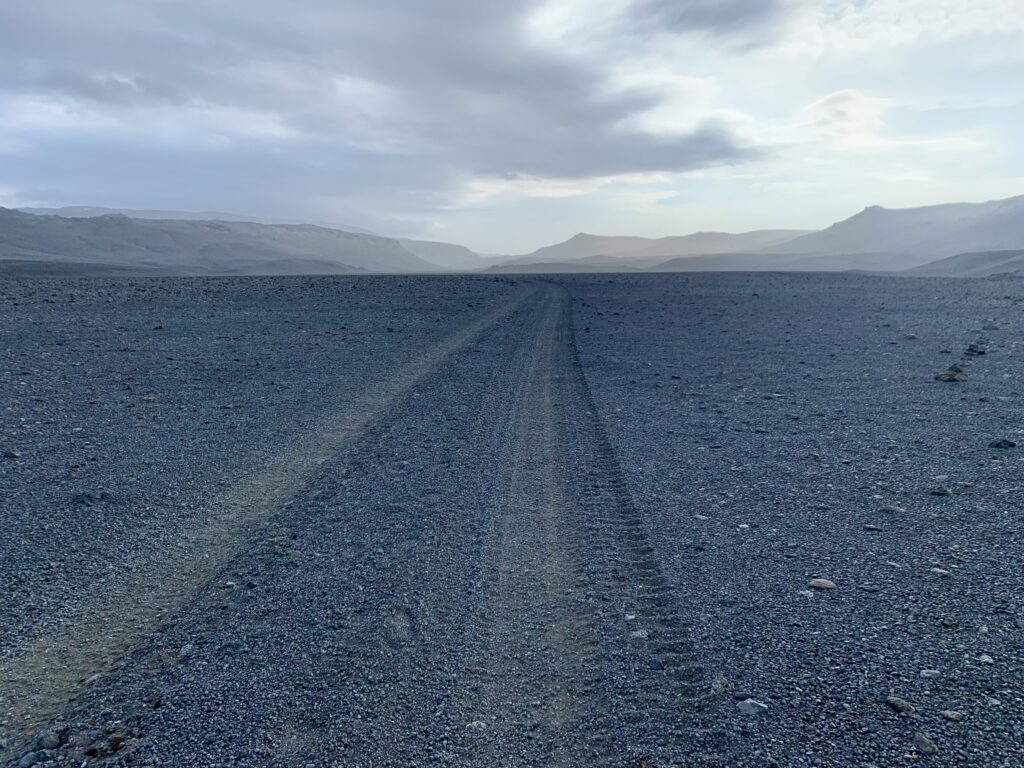
Endless gravel roads carry us towards the Dyngjufjalladalur valley as moody skies loom above. The moonscape turns briefly to green sheep pasture near an unnamed river that marks our turn. Continuing deeper into the Highlands, any remaining greenness soon fades to lava rock and desolation. We won’t see the sheep again until we’re at the southern coast.
Mid-morning, Botni hut provides a pleasant break from the wind. It’s howling today. I make tea and wish we could stay the night, but we have 14 more miles to our intended destination. A sign posted to the door states that our next water source may be dry. We don’t know how old the sign is, so we grab a little extra, but with already heavy packs, we roll the dice and hope the upcoming creek is flowing.
Exiting the hut, the wind has picked up and the mountains we’re hiking towards become veiled behind what at first looks like sheets of precipitation, but which turns out to be a cloud of sand. Entering the valley, the landscape funnels the wind, which is now gusting at 35-40 miles per hour.
I lean into the wind—a solid, invisible wall—forcing my body forward, toward the valley head. It takes the full weight of my body just to maintain balance. Next to me, I see Troy’s silhouette fighting the same impossible force, bracing against the whipping dust. The sky is gone, replaced by a churning, opaque fog of beige dust. Every inch of me is covered, yet the sand finds a way in. Beneath my buff, grit scours my teeth, and my eyes, burning behind sunglasses, water incessantly. All I hear is the constant rattle of thousands of grains of dust blasting the hood of my jacket. Two questions swirl in my head: What am I doing here? Why did I feel drawn to come here?
After a distance that felt much longer than it actually was, we’re at the Dyngjufell hut. We hadn’t planned to stay here, but it’s hard to justify hiking on in these conditions. Inside the vestibule, I force the door closed against the wind, stunned. It’s such a relief to be out of the sandstorm. On top of that, the water source, a small ephemeral snowmelt-fed stream, is flowing.
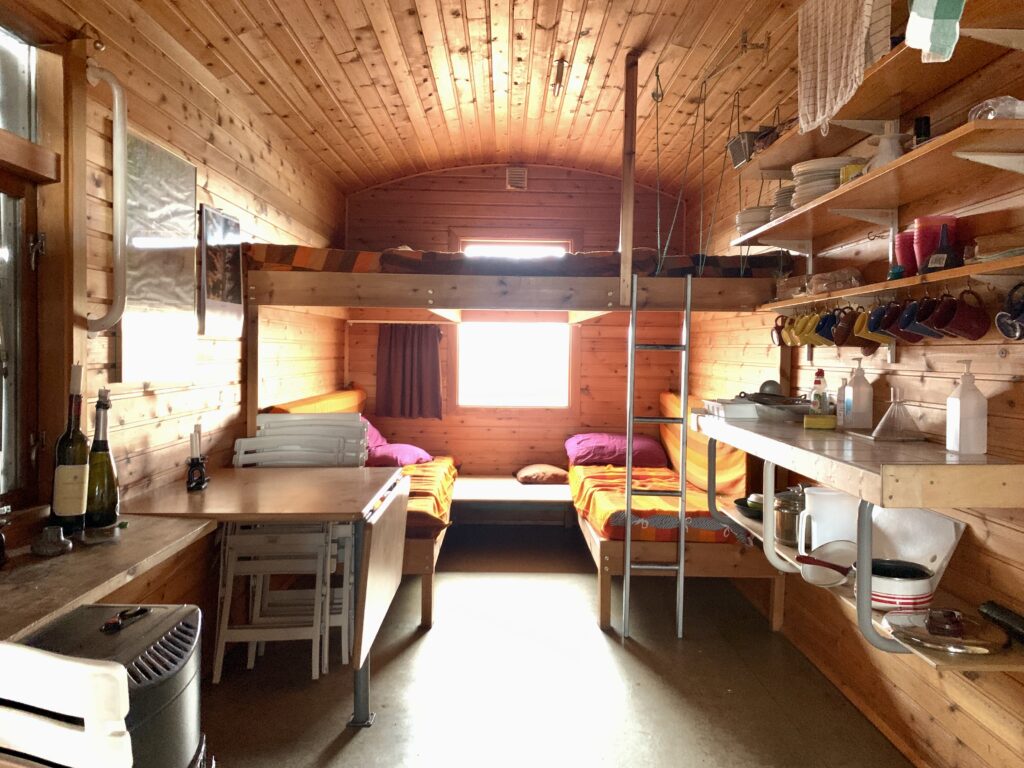
The hut is managed by Akureyri Touring Association of Iceland. The huts are not as common here as they are farther south, but several can be found scattered throughout the interior. Beds can be reserved in advance, and remaining spots are first come, first serve. Fortunately, no one else was here. At $50 per person per night, it’s not inexpensive, but when you need it, they provide refuge in a very barren, harsh, and remote volcanic landscape.
The interior is clean and simple, providing all that the weary traveler could ask for. A kerosene stove for heating, chairs, a folding table, bunk-style beds, a propane stove for cooking, kitchen ware, and I count, 25 brightly colored mugs. We talk briefly about the prospect of hiking on a bit, but the suggestion feels foolish when we, quite fortuitously, have this incredible place to sleep tonight.
Grateful to be inside as the gusts sway the structure and sand hammers the window, I can’t imagine trying to pitch a tent in this. An inreach forecast suggests that the wind will continue for the next two days, but that this is the worst of it. I stare out the window, content to be exactly where I am, with no internet access or chores to do or anything to distract. Just here. Now.
By dawn, the wind has relented to a steady 20 miles per hour, the sun is shining through and I see the surrounding mountains which were concealed behind dust yesterday. Just as our packs have gotten noticeably lighter, we load up with four liters of water for an all-day dry stretch. Just like every day on the Sangres Traverse. It’s particularly silty here. We didn’t bring alum but we’ll let it settle and decant off the top.
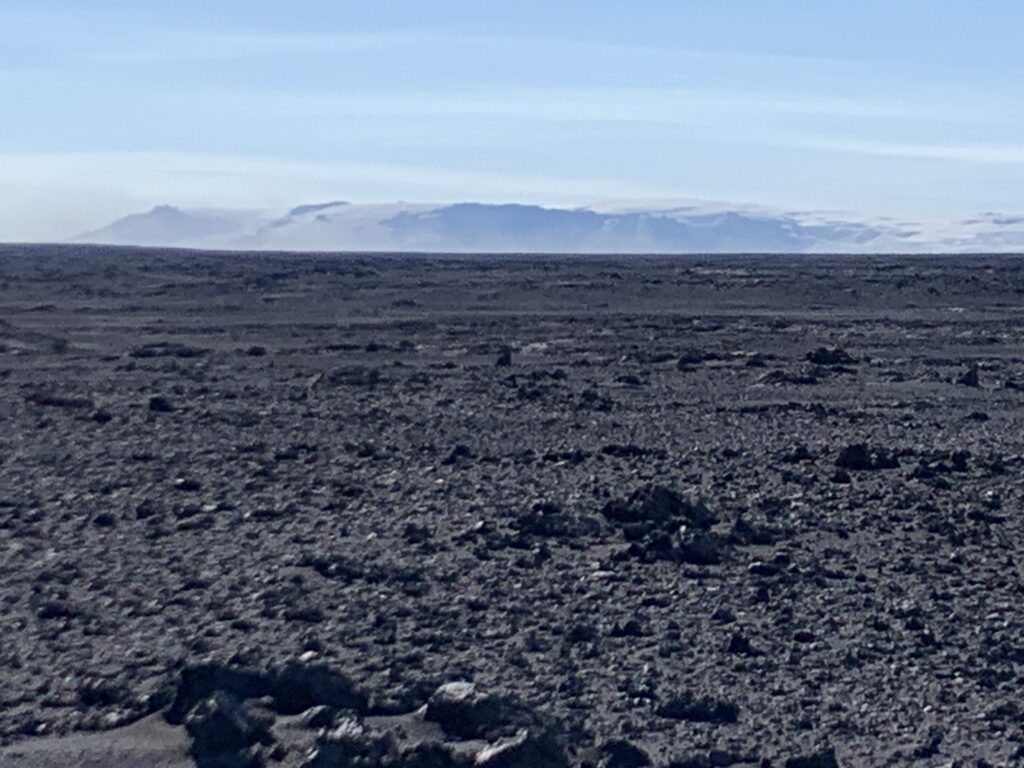
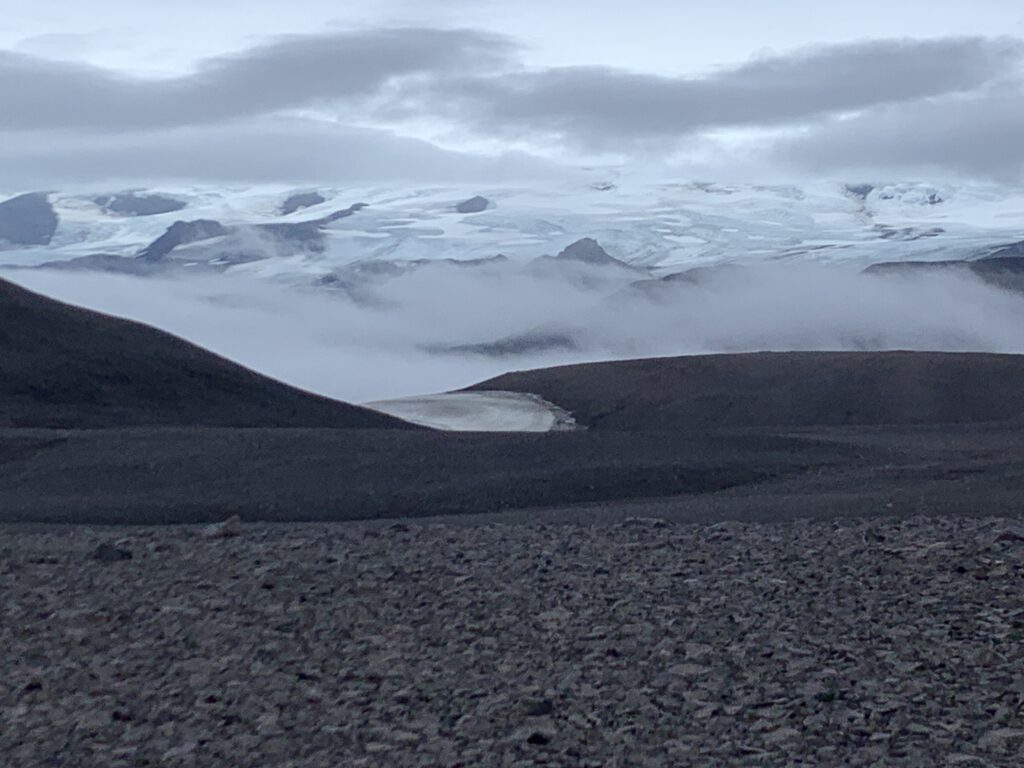
We continue our slow ascent towards the center of the island. Cresting the valley head, I see a massive cloud covering the entire horizon. I stare, trying to make connections in my brain, and realize I’m looking at the Vatnajökull ice cap. Covering eight percent of Iceland, it’s the largest ice cap in Europe, and the source of the river we first encountered on day two. Spindrift creates a snowy mirage above the surface and, as we cut west away from the ice sheet, I wonder what it would be like to walk along its edge, and regret that we didn’t plan our route that way.
With the exception of a few protected spots, the terrain is wide open and the wind is relentless today. The incessant noise is exhausting. Fortunately, the sky is clear and it’s sunny and warm. Vatnajökull remains a steady presence on the horizon, capturing our attention as the hours pass.
Still gusting when we reach our planned camp, the wind is coming from every direction, and despite our best efforts, there’s nowhere less blustery to set up. We select a large boulder and build a two foot tall rock wall around the sides of our tent. Even with our tent battened down as securely as possible, the DCF flaps incessantly. We crawl in, exhausted from fighting the wind all day, hoping our body weight will help stabilize the tent (it doesn’t). We unpack and soon there’s a fine black dust covering our quilts, food bags, and everything else. I clumsily prop up my trash compactor bag and empty backpack to cover the mesh. It’s marginally effective.
With earplugs and an eye mask, I manage to get at least some sleep despite the wap wap wapping of the shelter walls. Everytime I wake up, the wind is still at it. I bury my head back under my quilt. After much tossing and turning, I peak my eye out from under my eye mask and see light. Emerging from my cocoon, I assess the scene. Our bodies and all of our items have several millimeters of black sand atop them. The wind is still battering the tent. Ugh.
Feeling tired and defeated, we pack up, wrangling our tent into a ball, grit spraying in our eyes and mouth. Today is just a day of walking. For most efficient travel, we follow F roads, rough, unmaintained 4×4 tracks that create passage across the rugged interior. The wind continues. I have no poetic thoughts. I mentally count the miles to our next snack break, to water, to lunch. My mind needs more stimulation. I challenge myself to find the highlights: we’re getting closer to Vatnajökull, I see some River Beauties by a stream, we pass an unexpected waterfall, and my body feels strong. As I drift off to sleep, I’m buoyed by tomorrow’s forecast: dense fog, but no wind or precip!
Awake before my alarm, I notice how silent it is. It’s a silence I’m not used to. No birdsong, burbling creek, or wind. A total absence of sound. A low fog covers the valley. We’re walking in a dreamscape, slowly ascending. Cresting the watershed divide for northern and southern Iceland, the ceiling lifts enough to give us incredible views of Vatnajökull. We’re close enough now to see the many nuntaks, outlet glaciers, and textures of the ice.
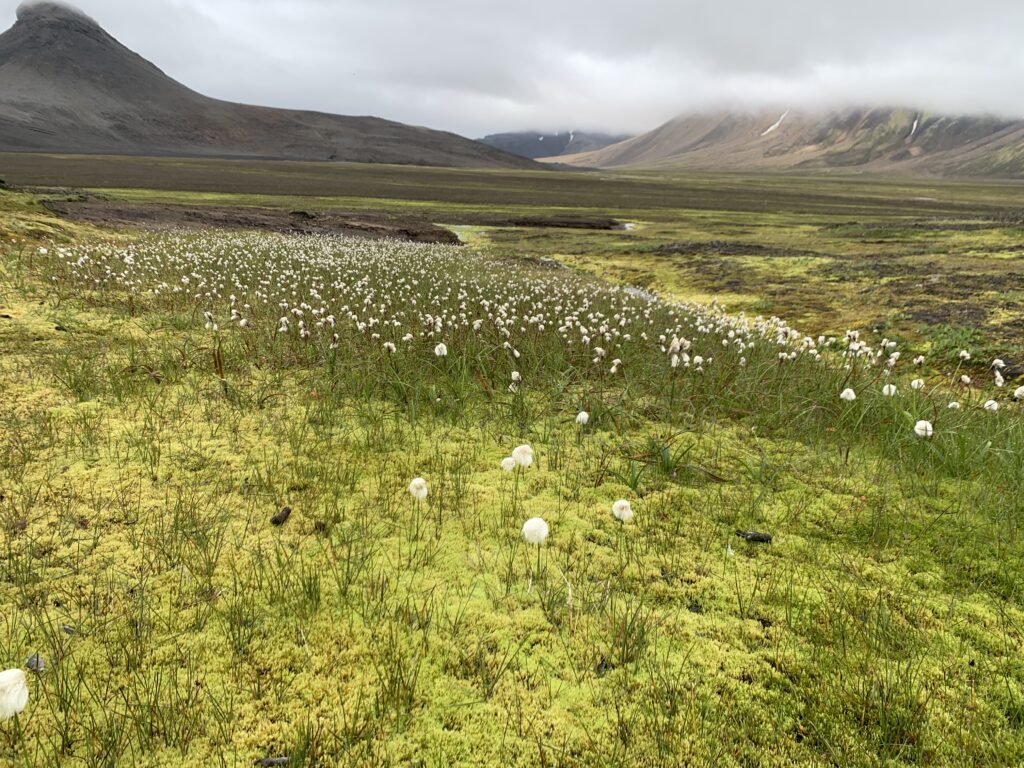
Dropping into a wide valley carpeted in lime green moss and criss-crossed by slow flowing river braids, I take in the rhyolite mountains with clouds draped over their peaks. It’s spectacular. Again, I notice the silence. With no megafauna, and very little human or air traffic, it feels liminal, like a forgotten wing of a museum that’s been closed to the public for decades.
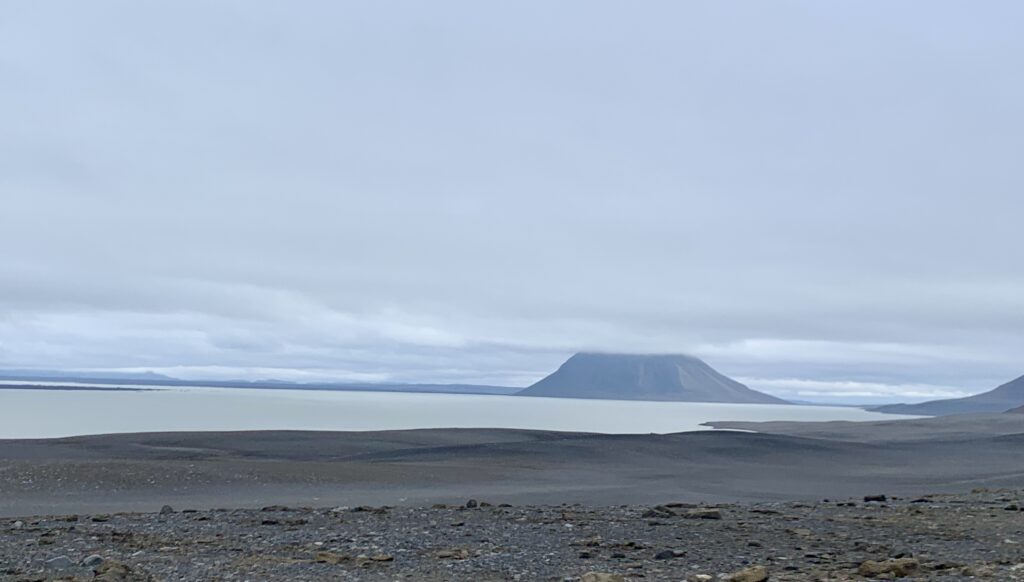
Crossing a steaming river, we skirt the valley where the footing is firmest, following yellow-capped posts. It begins to drizzle again as we crest a small pass from one valley to the next. The last hours of the day are spent walking the shores of the massive Hágöngulón reservoir. Today was my favorite day so far.
I awake the following morning to a dense fog, which finally burns off by mid-morning shortly after we intersect one of the main F-roads. I’m not psyched to be walking a road (even if it’s dirt) and I question whether I should be spending this time doing something else, like an alpine high route. It’s interesting, this recurring theme of questioning my decision to come here. But I don’t regret coming. It’s been a good experience for Troy and I. And the beautiful parts are outstandingly beautiful. And mostly, it’s the silence and the emptiness that I’ve really loved. I realize that’s what I was hoping to find here, and I did.
For the first time on the trip, the weather is nice enough when we set up camp that I can rinse myself in a nearby creek. It’s breath-takingly brisk and I savor the warmth of the weak autumn sun as I dry off afterwards.
The following day, miles pass quickly on the F-road and we’re rewarded with incredible 360 views of glaciers, mountains, and lakes. Traffic, unfortunately, picks up the farther south we go. We have to keep walking longer than we want to find a decent camp, but we finally come across a great little nook by the Tungnaá, an intimidating river that flows from the western edge of Vatnajökull.
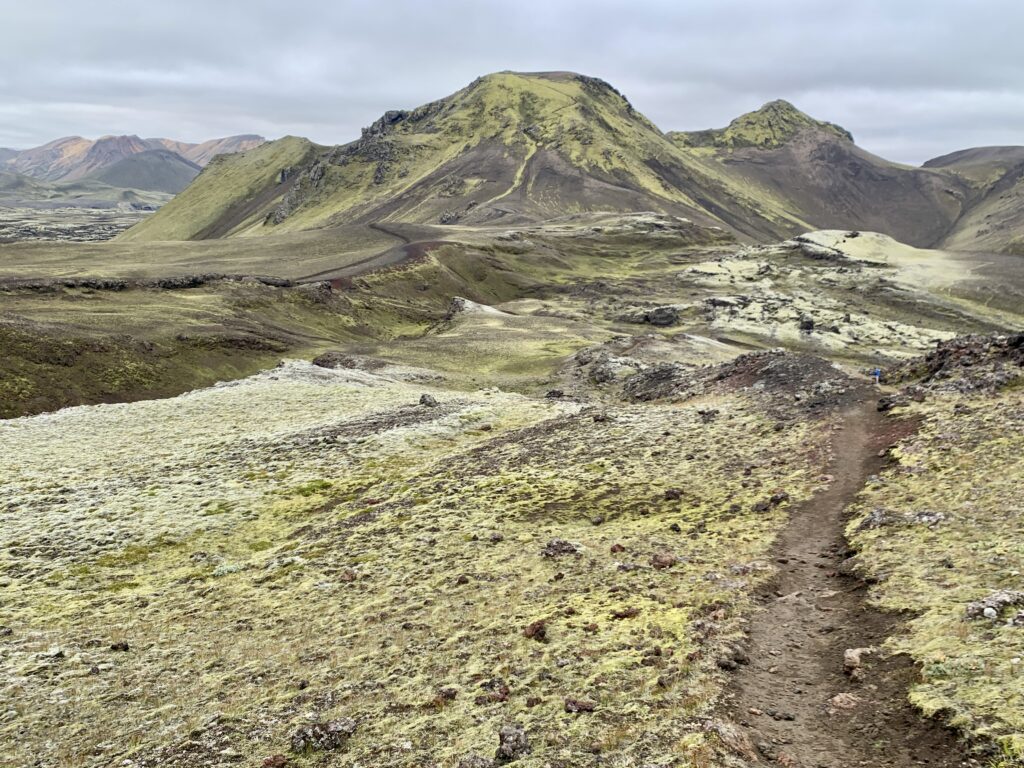
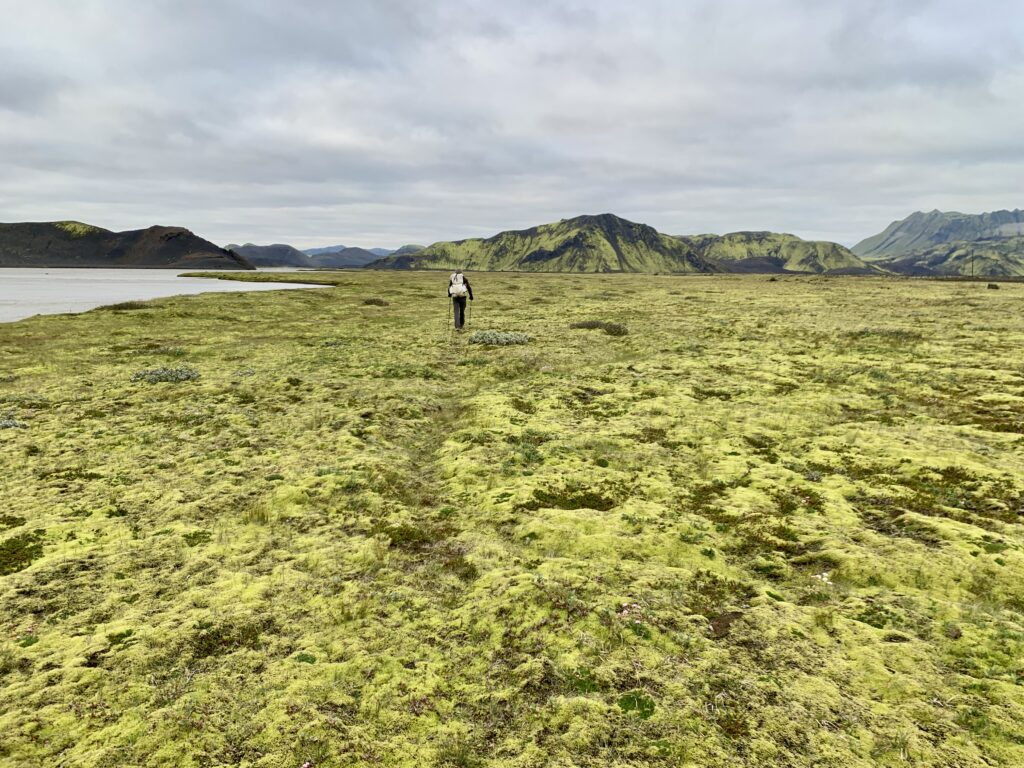
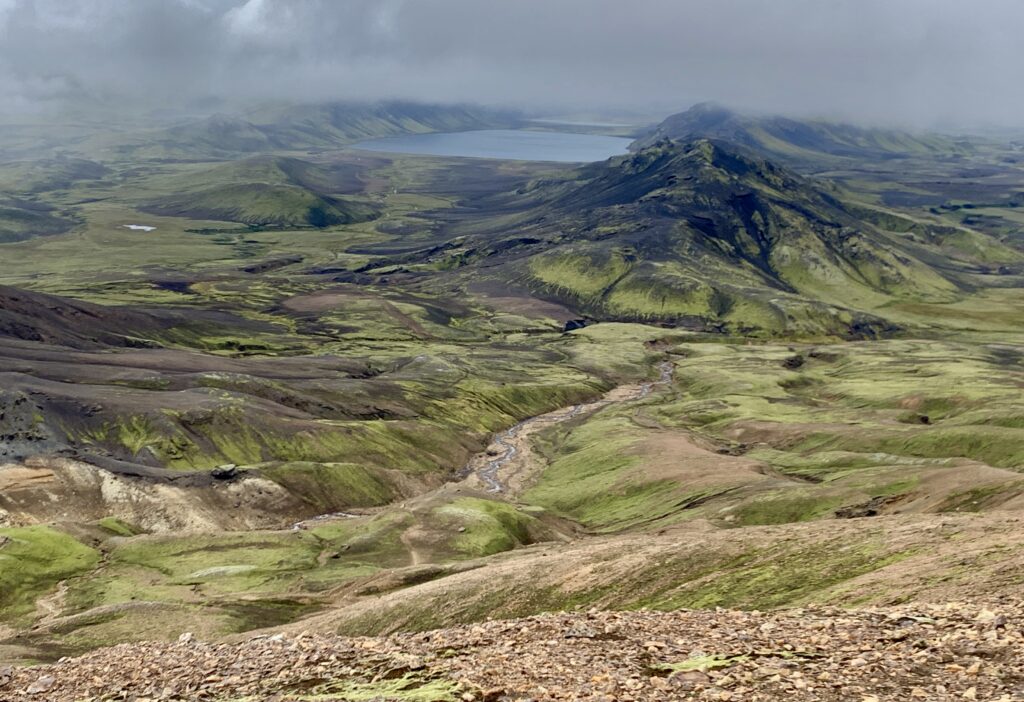
In the morning, we walk the final miles to Landmannalagur, aka the Promised Land. We’re walking through a lush, mossy green dreamscape and spirits are high. Thousands of viridescent veins weave through bands of obsidian rock on the mountainsides. We skirt the edge of a lake-filled crater with rhyolite cliffs. Finally, we’re walking in the mountains, not just near them!
Landmannalaugar to Skógar
Landmannalaugar, though a bit jarring due to the hoards of people, does not disappoint. We soon find ourselves at an adorable converted school bus that houses a small snack and camp supply store. There are no price tags. I’m pleasantly surprised by the variety of items they stock, from a plethora of camp food to bath towels and personal care items. I look for hydrocortisone cream to soothe the itchy blisters that developed on my knuckles a few days ago. Alas, there is none. I shrug and figure I’ll deal with it in a few days when we’re done.
Nearby signs inform me that Landmannalaugar translates to the People’s Pools and has been a rest stop for Icelanders for centuries. Historically, it was used as a place for sheep herders to rest after rounding up sheep in the Highlands. Currently, it serves as a tourist stop on the Ring Road and launching off point for Lagavegur trail hikers.
Unable to resist hot food that we don’t have to prepare on our camp stoves, Troy orders a grilled sandwich and I get a bowl of chicken soup. We add a bag of Lay’s, avocado dip, and two hot coffees. Basking in the heat of the kitchen bus, we eat with the intensity of starved dogs. It’s wonderful to feel full.
Next up is a soak in the natural hot springs. Steaming water pours from the cliff face into wide streams lined with tall grass. Stepping in, the water is so hot that I can’t stand it for more than ten seconds. I yank my foot back and try again farther downstream where the water has had time to cool. That’s better. I ease in and submerge my body. It feels glorious to get the grime off and allow the heat to soothe my muscles. Blessed with an uncharacteristically warm and sunny Icelandic afternoon, we crawl out and dry our bodies in the sun.
Warmed and relaxed, we return to the bus for more treats, savoring the amenities and opportunity for R&R before the push of the final two days. It’s hard to believe we’re finally here. The last two weeks have simultaneously gone both slow and fast. Long days, fast weeks. We’re eager for this next section, the famous Lagavegur and Fimmvodehauls trails. Be present, I remind myself, enjoy this last bit.
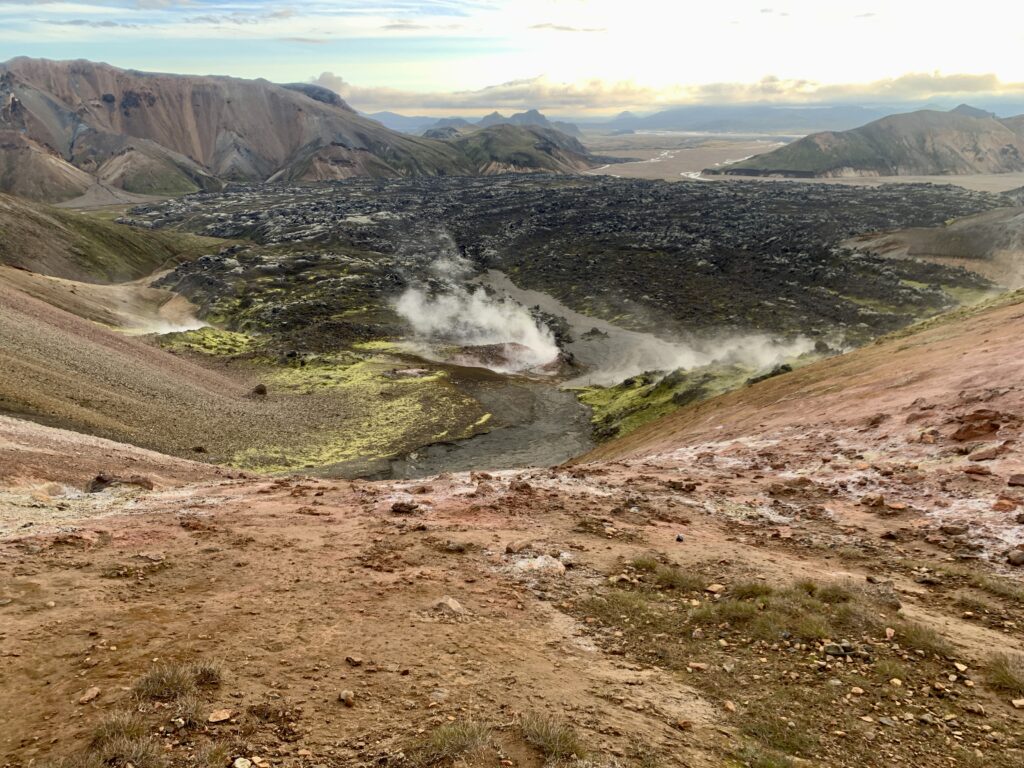
I sleep poorly in the crowded campground so we’re up and on trail early. Fortunately, no one else here gets up early so we have this otherwise popular trail to ourselves for the first several hours of the day. Climbing out of Landmannalaugar into the surrounding mountains, the hot springs shimmer in the morning light, billows of steam rising into the air. Geothermal features abound: fumaroles, boiling mudpots, open vents spitting steam, and multicolored mineral-coated rocks. I snap one photo after another, trying to take it all in.
The higher we climb, the more the wind picks up and soon we’re walking inside of a cloud. It’s very blustery and very cold. Well-placed cairns carry us to the Hrafntinnusker Hut, where we find temporary escape from the wind huddled behind the wall of the structure. We eat a quick snack, down some water, and carry on.
Despite wearing every layer I am carrying, I am deeply chilled; the coldest I’ve been on the entire trip. Still pushing through the fog, a light drizzle begins. I am walking as fast as I can, trying to generate body heat. I’m again taken aback by how quickly the weather can change from the pleasant heat of the morning to the frigid wind and rain we’re now walking through. Nonetheless, I think, the surrounding landscape beneath the cloud layer is still beautiful.
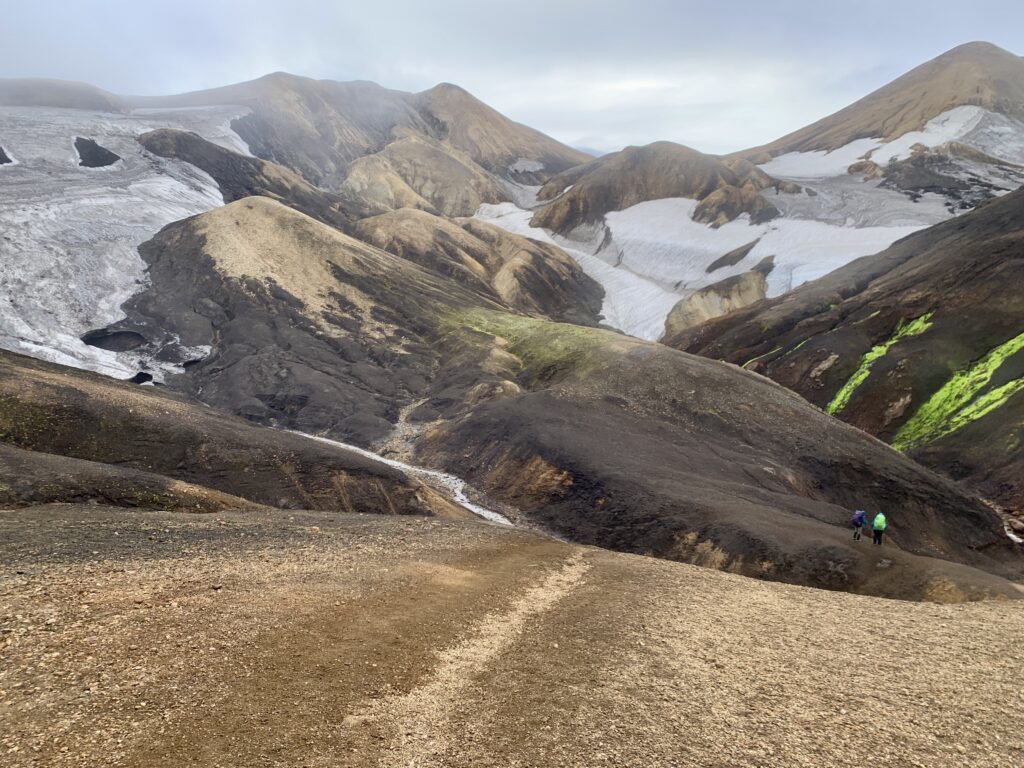
Dropping elevation, the fog thins as we walk below the Kaldaklofsjokull glacier and look south over the valley containing the Alftavatn lake and hut. We descend through beige, salmon, and rust colored peaks streaked with black obsidian, fluorescent moss, and crystalline ice. By the time we reach the hut, we’ve warmed enough to shed layers. Tucked out of the wind, we lunch on dates, peanut butter, and coffee.
Onward into the green wonderland, time passes imperceptibly amidst the engaging terrain. After miles upon miles of rolling roads over the past week, my body relishes the dynamic movement, the climbs and descents, the endless single-track carrying me from one beautiful valley to the next. For as well-traveled as it is, I am surprised by how rugged parts of the trail are: steep embankments, washed out drainages, ice crossings, and eroded slopes. In the afternoon, we ford the Blafjallakvisi, which is just over knee deep, but not flowing too quickly.
Our camp, near the Emstrur Hut, is perched in a lush little ravine, roughly two miles from the toe of a glacier that pours into the valley. Cozy in our tent, with blue skies overhead, we make tea and enjoy the satisfaction of a solid day. We finish tomorrow!
Sluggish with the cumulative fatigue of the past days and weeks, we roll out of camp with the knowingness that this is the last time we need to do this for the foreseeable future. The sky is clear and for the first time in a while, I am hiking in just my sun hoody as we cross the narrow gorge of the Fremri-Emstrua on a precarious bridge.
I feel the sharp rise in heat and humidity the lower we drop and the closer we get to Þórsmörk, the terminus of the Laugavegur. Before reaching the small village, we ford the Þröngá. It consists of several knee-deep braids, and is faster flowing than the other rivers we’ve encountered. Safely on the far bank, we enter a national forest composed of birch trees. I haven’t seen trees since we left the northern coast, and it feels wonderful to walk beneath the canopy. I notice gold and crimson tinting the leave’s edges. Fall comes early to the (sub) arctic.
Þórsmörk consists of a few bunkhouses, a campground, a WC, and a small store. As a popular tourist stop and terminus of the Lagavegur, there are many people coming and going. With another sixteen miles and 3200’ of elevation gain ahead of us on the Fimmvörðuháls trail, we have a quick coffee and protein bar and push on. The Fimmvörðuháls climbs up out of Þórsmörk, passes between the Eyjafjallajökull and Mýrdalsjökull glaciers, and then descends to Skógafoss waterfall on the southern coast, where we’ll end our journey.
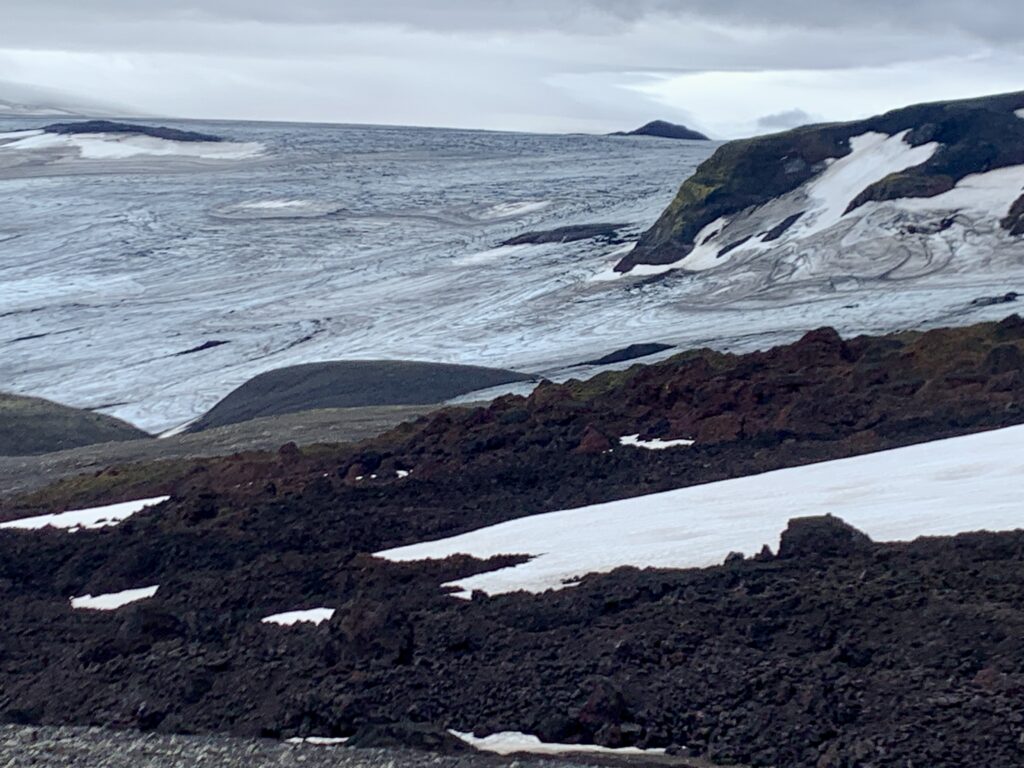
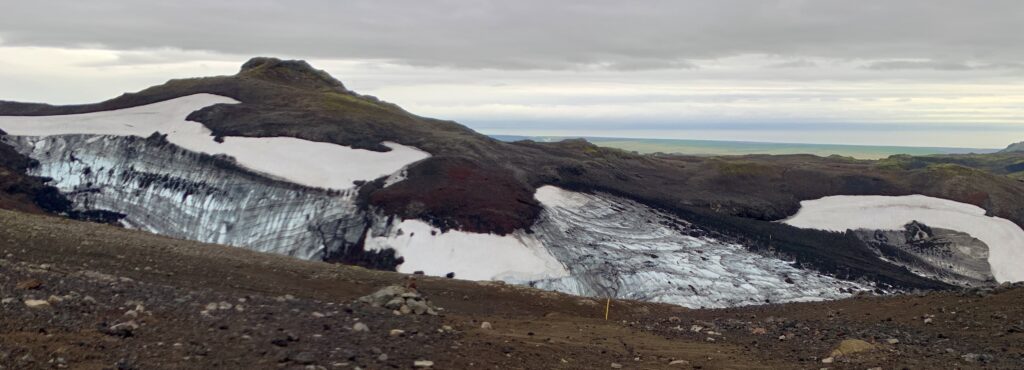
We walk the spine of a verdant ridge, water gushing from nearby waterfalls and through the valley below. Clouds thicken and as we climb higher, strong wind drives rain into our faces. The higher we go, the harder it blows. I worry about the next few hours of the hike as we’ll have to go farther up before we can go back down. Pressing on, we top out in a lava field between the two massive glaciers, famished from the climb and the cold. I remember to look up and I am awed by the textures and swirls in the ice, so close I can nearly touch it.
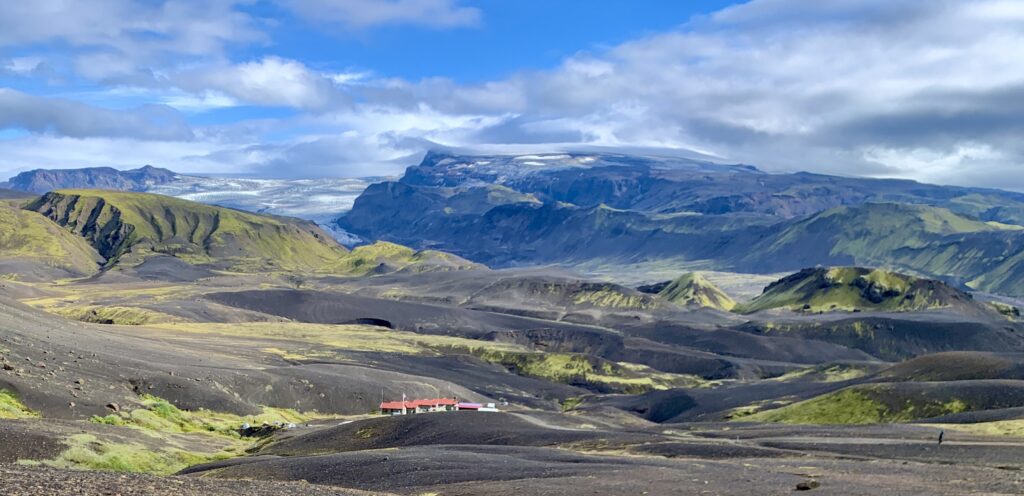
We eat a quick lunch in the sheltered lee of a giant caldera—a barren, black expanse that feels like the moon—before continuing on through a snow field and over a rise, where we catch our first glimpse of the southern coast and the gray ocean beyond. After two weeks focused only on the next step, seeing the horizon—the literal end—felt like a physical release of tension. Working our way through muddy rivulets across the toe of a glacier, we slip and slide on the ice. Adrenaline all but shot for the day, the final eight miles are slow as we descend towards the sea.
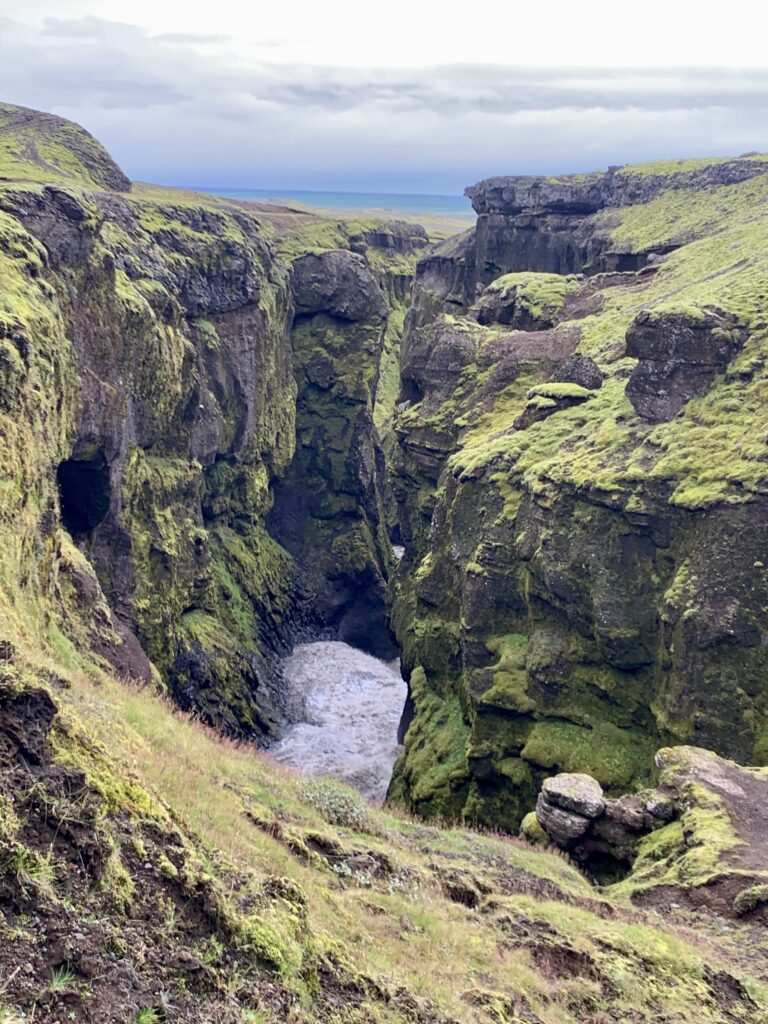
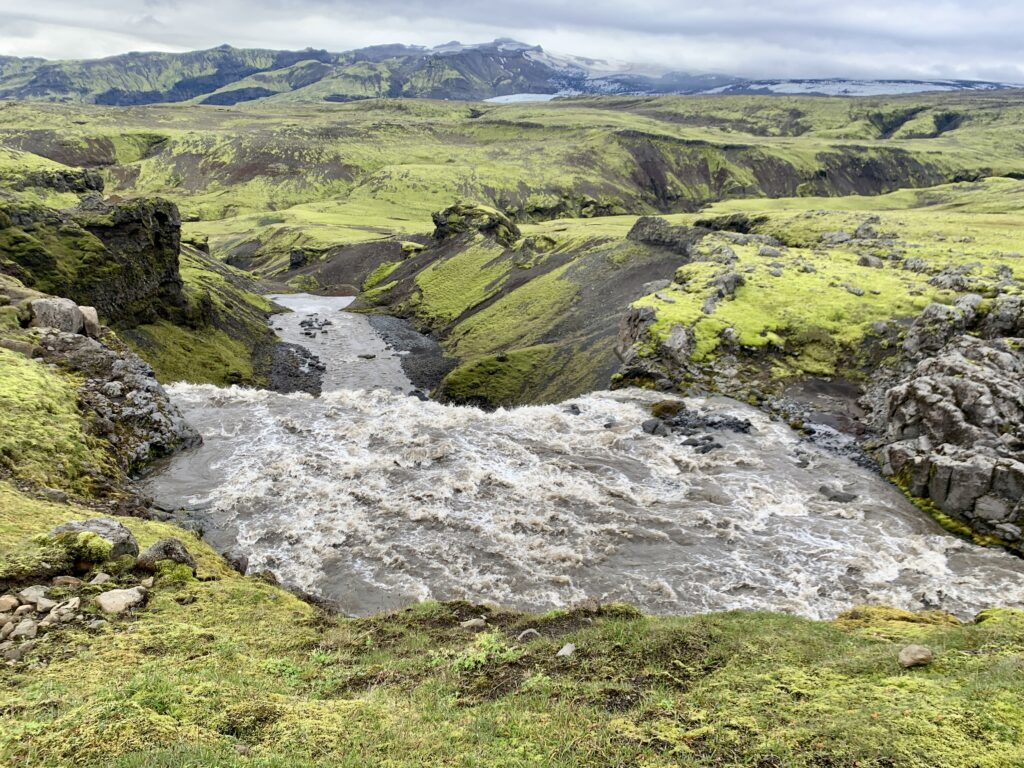
Intersecting the Skógá river, we hike along its bank, passing one waterfall after another through a whimsical valley. Crowds thicken as we close in on Skogar, our endpoint and a popular destination on the Ring Road. It’s obvious why all these people come here, of course – it’s extraordinary. It’s also a stark contrast to the paucity of people we’ve seen over the previous twelve days. I am glad we experienced Iceland the way we did; by crossing the country on foot and confronting its less-traveled interior. It felt like we earned a raw, honest taste of this magnificent, unforgiving island.
We treat ourselves to Kristalls from the camp store and set up our tent near the river, hoping to drown out the tourist noise. Tomorrow we catch the bus back to Reykjavik. Shortly after we tuck-in for the night, it begins to rain hard. It lasts all night and into the next day. I think about how lucky we were with the weather; how good it feels to not have to walk in this today.
As the bus pulled away from the coast the next morning, the rain was still falling. We were trading the vastness of the Highlands for the crowds of Reykjavik. Yet, I didn’t feel a need to rush back to the noise. The two-week crossing, with all its beautiful stillness and brutal wind, had served its purpose. I had found the vastness and simplicity I’d unknowingly sought. I was grounded by a deep appreciation for the quiet, difficult spaces in life—both on the map and within the mind. The journey is over, but the wide-open expanse of Iceland remains, and the stillness I found there comes home with me.
Earlier this week, Andrew and I hosted a tutorial covering the foundational skills and gear needed for backpacking in the desert. I wanted to share it with you in case you missed it!
It may feel like deep winter in many parts of the northern hemisphere, but the desert hiking season kicks off in just a few short months. I hope these resources help you feel prepared to get out there!
If you’re interested in our healthy, lightweight backpacking course, check out the details here (it’s free!).
I want to share an alternative approach to annual reflections and setting goals that helps to create a life that feels meaningful and rich to YOU.
My current favorite structure for reflecting on one year and setting goals for the next is the same debriefing exercise I use each evening on guided backpacking trips.
It’s called roses, thorns, and buds.
Here’s how I do it:
I scroll back through my google calendar (because it’s easy to forget what happened last week, let alone 12 months ago!) and I look for highlights or accomplishments (roses), events that were challenging or didn’t go as planned (thorns), and lessons that I want to carry into the coming year (buds).
This exercise not only fills me with gratitude for what went well, but self compassion for what didn’t go so well, and ideas for how I want to set intentions and goals for the coming year.
How do you then choose goals that are actually meaningful to YOU and help you create a life that’s uniquely yours; a life you love?
I look through my roses to see what core values they represent. Why were they roses? What do they reveal about what matters to me at a core level?
For example, some themes I noticed: physical and mental health, time spent intentionally (outdoors, with friends and family), service and mentorship, physical challenge, skill growth and learning.
I use this information to create goals for the coming year that encompass these values (rather than arbitrary goals that are defined as the gold standard by society, but which are meaningless to me).
If the goal is not an expression of, and in alignment with, who I am and who I’m becoming, I’m unlikely to stick to the actions needed to achieve it, and at this point, I’m simply not interested.
As I consider where I want to focus my attention in the coming year, I’m asking myself: What is in alignment with my core values? What kind of person do I want to be and how do I want to shape my character?
Once I have a concrete goal, how do I get there?
Because a goal without a plan is just a wish.
When I work on my own goal list or support clients with theirs, we start with breaking the goal into manageable steps, each of which is made up of quantifiable actions (e.g. to run a marathon, I need to run x minutes per week). Those specific actions must then be scheduled as specifically as possible (e.g. I’ll run 30 minutes on Monday, Wednesday, and Friday at 8am).
BUT THAT’S NOT ENOUGH.
How many of us know what to do but don’t do it?
The key to doing what we say we want to do is in rewiring our habitual thoughts and behaviors so that our subconscious, which is responsible for 90% of what we do, is on board. This can be done through neuroplasticity tools, like pattern interrupts and mental rehearsal. Our brains can change at any age, which is very exciting!
And one last reminder on goal setting:
Even though I’m writing this at the start of a new year, that’s an arbitrary date on the Gregorian calendar. You are on your own timeline. Please do not pressure yourself with artificial deadlines.
May we divest from the diet culture mentality of extreme action and quick fixes, and instead set goals and act from a place of what’s aligned and sustainable for each of us.
Happy New Year, friend.
Katie
PS. I’m currently taking on new 1-1 coaching clients.
What do you want to achieve in 2024?
Whatever your goals and wherever you hope to go, I’d love to help you get there.
One of the ways I do that is through private coaching. By working together 1-1, I’ll support you in achieving your health and/or adventure goals through a customized program centering on any/all of the following:
dialing in a sustainable health routine so that you have the mental and physical energy for everything that matters to you in 2024 (including better endurance and recovery on trail)
using neuroplasticity techniques to change unwanted habits and wire in new ones so that you can finally follow through on your goals
guidance with trip planning, gear selection, trail nutrition, and more so that you can spend more time enjoying the outdoors.
Feel your best and be able to say YES to any adventure that comes your way!
If you’re curious about coaching with me and how it might help you reach your goals more enjoyably and sustainably this year, contact me. From there, we’ll chat about what to expect from coaching and whether working together is a good fit. There’s no pressure and no obligation.
One of life’s greatest pleasures during the season of long nights is curling up with a good book and a cup of tea, and allowing your mind to dive into a world of new ideas.
As such, I want to share a few of my favorite books from 2023.
In reflecting upon a year of reading, I see my priorities not only in how much time I could devote to reading, but in what I chose to focus my attention on.
This list represents just a small fraction of the books I read this year, and it contains both old and new publications. It is, of course, entirely subjective, but perhaps there will be something here that jumps out at you and has the potential to enhance the quality of your life in the coming year and beyond.
I’m always striving to better understand the forces that have shaped the natural world around us and this book does that on a grand scale. In it, author Dan Flores explores a deep-time history of the coexistence of animals and humans in North America. He details the astonishing bestiary that arose on the continent (saber tooth tigers! short-faced bears! giant ground sloths!) and how the arrival of humans precipitated an incredible disruption of this environment. This tome is one I’ll definitely be revisiting.
I like to think that after two decades of studying nutrition science and physical wellbeing, I’m fairly well-versed in the field; and yet, this book was eye-opening. Through his own journey to better health, the author shares the history and science of how our modern lifestyle negatively impacts our breathing, and the drastic ramifications on our physical and mental health. Practical solutions for improving our breathing, and therefore our health and longevity, are included.
This selection may seem extremely niche, but it’s representative of a genre of books I was enraptured with this year, including other titles such as Colorado 14ers Disasters and The Greatest Search and Rescue Stories Ever Told, and even Over the Edge: Death in the Grand Canyon. There’s so much to learn from the stories of others who didn’t come home from their adventures. I find that studying these tales is not only beneficial for keeping my partners and I safe on personal trips, but also for understanding the time- and energy-intensive nature of backcountry rescue missions.
I think a lot about my own mortality. This is not due to a preoccupation with the macabre, but because, like the Stoics suggested, contemplating my own mortality encourages me to make better use of my limited time on earth. In Four Thousand Weeks, which is the number of weeks you have if you live to be 80, the author examines our fraught relationship with time. He offers thoughts on why we should think about time through the lens of our mortality rather than by searching for the perfect productivity app. This book paired well with Stolen Focus: Why You Can’t Pay Attention–and How to Think Deeply Again by Johann Hari, which explores how technology is shaping the way we think and how we can reclaim our attention.
Written by one of Colorado’s most well-known guide book authors, this selection shares Gerry Roach’s mountaineering tales from the 1950s and ‘60s, along with the life and mountain lessons they revealed to him. Through personal narrative, he speaks to the transcendent experiences many of us encounter in the outdoors–a topic I never tire of. It also provides a fascinating glimpse into the early days of climbing culture in the Front Range.
Have a book (or books) to recommend? Comment below.
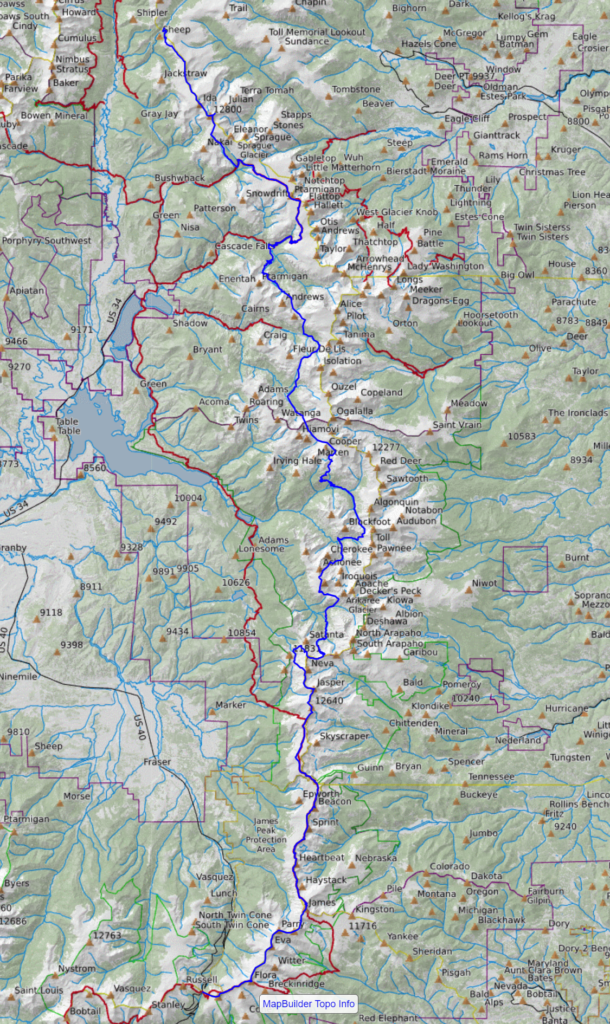
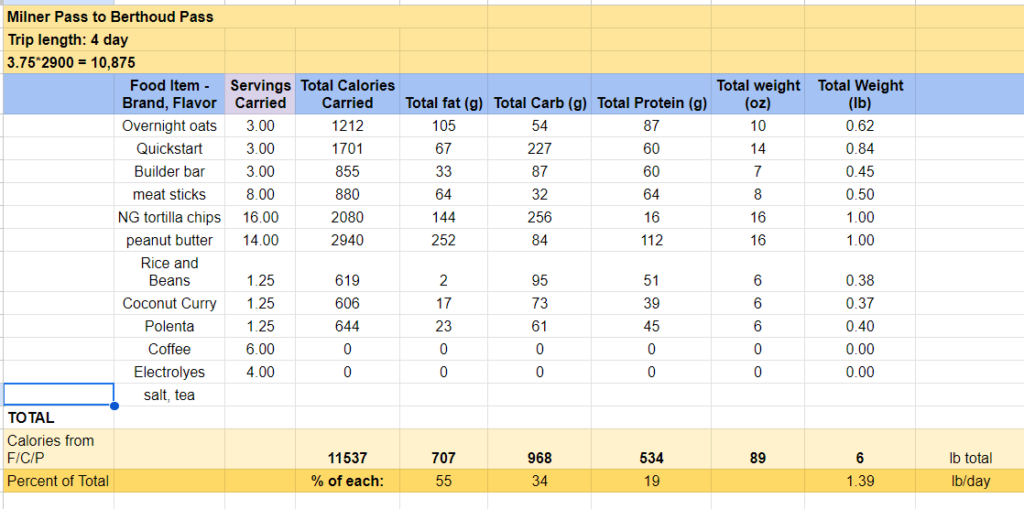
In September of 2023, I completed the Pfiffner Traverse. The Pfiffner is a high route that follows the Continental Divide along the crest of Colorado’s Front Range between Milner Pass to the north and Berthoud Pass to the south. This post provides a brief overview of the route as well as reflections from each day, a gear list, meal plan, and a few photos.
Pfiffner Traverse Overview
The primary route as outlined in Andrew’s guide (details below) is about 75 miles long with 28,000′ of elevation gain. It’s comprised of sections of established trail, including portions of the Continental Divide Trail (CDT), as well as sections of cross country travel, which make up about 40% of the total mileage. The technical level of the terrain is mostly Class 1-2 with occasional sections of Class 3 travel. I hiked solo and completed the route in a little less than four days.
The route drops below 10,000 feet only twice. It’s an engaging line with ridge walking and expansive views in the northern section, pass-and-basin terrain throughout the middle, and caps off (for southbounders) with a nine mile ridge walk that traverses five 13ers before dropping down to Berthoud.
While it can be hiked in either direction, I chose to hike southbound due to logistical reasons. Starting at Milner Pass allowed me to plan my RMNP campsite reservation more accurately, pick up my backcountry permit on the way to the start of my hike, and to more easily arrange my transportation (leaving a car at Berthoud Pass and being dropped off at Milner).
My goals were to:
Move light and fast, testing my alpine fitness
Enjoy solo time outdoors in beautiful and challenging terrain
Visit seldom seen areas of Arapaho NF and RMNP
Spend a few nights sleeping outside during one of Colorado’s dreamiest months
Get out for one last multi-night high country trip before before guiding in West Virginia in early October, after which access to the alpine becomes hit or miss
History
I find the history of this route fascinating. Karl Pfiffner was a Boulder-based mountaineer in the 50’s. He died in an avalanche on La Plata Peak when he was just 25. He was a friend and climbing partner of well-known (if you’re a Colorado outdoors-person) mountaineer author Gerry Roach.
In Gerry’s book Transcendent Summits, he writes “One of the projects that Karl had talked about doing was traversing the Continental Divide between the Arapaho Peaks and Longs, and he was making plans to do this traverse in the summer of ‘60. I resolved that I would someday do the traverse in his memory. Indeed, decades later, an extended version of this traverse still carries Karl’s name, and the next generations would do well to remember the namesake of this route.” Roach hiked a version of the route in 1987. You can read more about the history of the route on Andrew’s site.
This comprehensive guide contains a mapset, datasheets, permit information, and route description among other resources. I found it particularly helpful as I didn’t have much time to plan. As with any outdoor endeavor you still need the fitness and appropriate skill sets to complete the route, but you’re interested in this route, there’s no better place to start.
NWS point forecast
In the week leading up to the trip, I regularly checked forecasts from locations at varying elevations and locations along the route, such as Milner Pass, Thunderbolt Peak, and Berthoud Pass. This informed last minute gear decisions.
CalTopo
I primarily used this mapping software to sketch a digital route as well as alternates based on descriptions in the guide. This was meant to accompany my detailed printed maps if needed. I also used CalTopo’s sentinel layer to check snow conditions in the NE Gully.
Trip reports
I looked for recent trip reports to assess the amount of snow in the NE Gully to ascertain whether I needed an ice axe and/or spikes. I found one or two reports from 2023, though only one was even somewhat helpful since it was from within a month of my start date.
Timeline
Having completed the Sangre de Cristo Traverse a month earlier, I was in decent alpine shape and I wanted to use this trip as an opportunity to push myself. I determined my timeline based on my daily vertical limit, which was around 7000-8000 feet per day. Based on my experience in the Sangres, I was fairly confident I could sustain that pace for the duration of this route, which would equate to roughly four days (28,000 feet of total vertical divided by 7,000 feet per day).
Weather. The route spends several continuous miles above treeline at various points. As most hikers familiar with mountain travel are aware, weather can move in abruptly. There are lower elevation alternates that can be taken for most sections of the route. I was aware of these, and as I describe below, still found myself outrunning an afternoon storm on day one.
Elevation. Since I live at 7,000’ and hiked this route after a summer spent backpacking above 10,000’, I didn’t find this to be an issue. But it’s an important planning consideration for anyone coming from sea level.
Vertical per mile. With 760 feet of climbing or descending per mile, the vertical change is steady throughout. Good to be aware of this and plan your itinerary accordingly.
Highlights
Hiking the first couple of miles with my mom and brother
Engaging route finding and following bits of elk trail
Golden aspens, crimson ground cover, and frosty morning vegetation
Elk bugling in the valleys
Long nights, crisp mornings
Solo mountain time
My moose encounter (details below)
Hiking through pristine alpine lake basins in lesser visited parts of RMNP and Arapaho NF
Seeing very few people despite being less than two hours from Denver
Pfiffner Traverse: Day by Day
DAY 1
Miles: 19
Vertical gain: 5300’
After coffee, an elk sausage frittata, and a large side of fried potatoes, which I dutifully finish reasoning that I’ll be grateful for the calories later, my mom, brother, and I depart Grand Lake, and head for the Kawuneeche Visitor Center. After a brief chat with the ranger, I have my backcountry permit in hand and we’re winding our way up towards Milner Pass.
The plan was for my family, visiting from Ohio, to hike with me for an hour or so before heading out through Estes Park and onward to DIA. Though they’ve always been supportive of my hiking habit, they’ve never been physically present for the beginning or end of one of my trips. We didn’t backpack together when I was young, but we spent a lot of time outdoors – spring morel hunting, summer car camping, winter skiing, autumn glassing for deer. They’re the reason I feel so at home outdoors and it felt special to have them here.
Our 10:30am start is later than ideal, but I decide that it’s acceptable because the chance of precipitation is only 30%, the mileage to my RMNP campsite isn’t far, I have low elevation alternates if needed, and ultimately, the time with my family is priceless. We enjoy a few miles together, and too soon, it’s time for them to turn back. After hugs and well wishes, I head up the trail solo, a heaviness in my heart.
Gradually ascending to the ridgeline with gorgeous views of the surrounding ranges, the mid-September air is crisp and perfect. I’m watching the weather that’s building to the east. Passing a few parties of hikers, I depart the trail and push to get over Mt Ida as the wind picks up. The weather blows in fast and graupel pelts my face as I crest Ida and begin scrambling down the south side to the relative safety of the saddle. With my attention fully focused on the sky, I stumble on some talus, and full send. I stand to find a large bloody scrape on my left thigh and a sore right knee. Okay, off to a good start.
Sheltering behind a boulder, I throw on layers, inhale a snack, and check my map for a lower elevation alternate. At the Chief Cheley saddle, I make the conservative call and head down towards a low route. About 200 feet down, the graupel stops and it looks like the storm has blown over. Not wanting to give up my hard-earned elevation gain, I stupidly begin to side hill on talus around Cheley. Upon becoming sufficiently annoyed with this plan, I crawl up class 3 terrain on the east face to regain the ridge where the easier walking is found.
I enjoy an hour of sun before the next squall hits. The snow begins as I descend past Haynach Lakes and fortunately, already under tree cover. I join the CDT and power up through a burn area in the Tonahatu Creek drainage, feeling strong. Back above treeline, I spot more weather to the north. It’s slowly moving my way. Knowing I’m exposed for the next five miles, I pick up the pace. Anxiety builds as the storm inches closer.
Just as I hit the south side of Ptarmigan Pass, the snowfall begins again. Thankfully, I’m beginning my descent towards North Inlet and tonight’s campsite. Within moments, the entire sky is a deep bluish purple and it’s clear this squall is more serious. A loud clap of thunder rattles above. I race toward treeline and the descent into Hallett Creek as the snow pummels my bare skin. Around 10,000 feet, the snow turns to rain, and it’s not long before I’m soaked and cold and my hands are going numb. With the fading daylight, there’s no chance of drying out as I descend into the trees. In an act of mercy from the universe, the rain finally clears and golden beams of the day’s last light shoot through the pines, diffusing the most celestial light throughout the misty valley.
Down down down, I finally reach camp around 6:45. Wet and cold, I fumble to set up my shelter with my barely functioning hands, the task taking three times longer than normal. I peel off wet layers and get something dry on, the adrenaline slowly clearing out and the exhaustion settling in. Gather water, crawl into my bag, and get some hot food going. Finally able to relax, I study my maps, hoping for a better weather day tomorrow.
DAY 2
Miles: 19
Vertical gain: 7600’
Sleep is intermittent as I have weird dreams and vague worries about putting on wet clothes and walking through more storms. I awaken groggily to the sound of my alarm at 5:33. Frost covers my tent and I can see my breath. Lighting my stove for coffee, I decide I’m not walking until it’s light. Even though I know about the potential time sucks I could encounter (difficult off trail travel, navigational errors, and weather), I’m dragging my feet. Know better, I tell myself that even if I leave by 7, I still have 12 hours of usable daylight. I text Troy for an updated forecast and eat slowly.
Having consumed my coffee and breakfast and with no other ways to procrastinate, I crawl out and pack up my frozen, wet shelter. Even with gloves on, my hands become numb. Ascending through the trees on snow-dusted trail towards Lake Nokoni, it’s cold, but beautiful as birds chirp and the sky lightens. I’m grateful for the elevation gain as my working muscles generate body heat.
Lakes Nokoni and Nanita are the most picturesque alpine lakes and I wish I had time to linger. Orange and yellow leaves lay atop a crimson ground cover. I remember that it’s the 21st. Happy first day of autumn, I say aloud. At the saddle above UN Lake 10584, I’m finally in full sun, and I stop for a snack. It’s chilly and the sun feels wonderful. I get a message from Troy that the radar looks better for today. I hope it’s accurate.
With more optimism in my step, I push on, up over a pass, down into a basin, up over a pass, down into a basin, and repeat for the remainder of the day. Departing Beak Pass, I make my way down through forest and over blow downs to East Inlet, where I pick up good use trail around the lakes. On the south side of Isolation Peak Pass, I cruise bits of elk trail through the remote and aptly named Paradise Park, and exit RMNP via Paradise Pass. I skirt along the east short of Upper Lake, stopping to refill a bottle. Resting on a rock in the sun, I eye Cooper Peak Pass, which looms 1100’ above me. Climbing up the steep tundra, then talus, I reflect on another summer coming to a close and what am amazing one it was. Soon, I’m up and over, descending the talus towards Island Lake.
Around 4pm, a storm moves through the next valley to my east. Flashing back to yesterday, I get a bit nervous, but it passes by without trouble. I pick up trail near Gourd Lake and make fast miles until shortly before dark when I hit the junction of Buchanan and Thunderbolt Creeks, where I begin to look for camp.
I’m disappointed to stop 1.5 miles and 1,000’ short of my goal for the day, but due to the late start and slow off trail travel, I’m not surprised. I find a protected spot in a pine grove just north of a chilly-looking meadow. I’m grateful to be warm and dry as I set up my tent with fully functioning hands. I cook dinner as the last of the day’s light drips from the sky. Just as I start to eat, I’m startled by a loud rustling very close to my tent. I fumble for my headlamp and scan the pine grove. The beam catches a set of glowing deer eyes staring back at me just 10 feet away.
I get a message from Troy informing me that tomorrow’s forecast looks clear though I may get a storm tonight. And just as I read it, a clap of thunder booms overhead and rain starts to fall. Grateful to be in my cozy nest, I study tomorrow’s route. It will be another long day with the most challenging terrain encountered thus far. I remind myself that I planned it this way as I drift off to the sound rain on my tarp.
DAY 3
Miles: 14
Vertical gain: 7500’
After a night of decent sleep, I’m hiking by 6:30 and there’s just enough light to not need a headlamp. I walk along the timber at the edge of a meadow through frost-covered grass, noticing the temperature difference between my campsite and the frigid meadow. Shortly thereafter, as I exit the meadow to the south, I’m startled by loud grunting and brush thrashing sounds coming from behind me.
I whip around to see a bull moose charging straight towards me through the meadow. It quickly becomes clear that it’s not veering off its course. Frantically, I search for an escape. I know I can’t outrun it so I break through a mess of dead limbs and force my way up the trunk of a blowdown that’s wedged against a standing tree. It’s not much, but this at least gets me 7-8 feet off the ground.
Just as I’m positioned in the tree, the moose bursts through the edge of the timber 30 feet away and stops to look around. I make a loud noise foolishly thinking I’ll scare it off. Looking in my direction, it strides fifteen paces closer, snout uplifted, sniffing my scent on the air. Suddenly I remember that moose have very bad eyesight and I stand as still as I possibly can. After a few minutes of staring straight at me, it turns its massive head, thrashes some brambles with its antlers, and begins to wander up-valley in the same direction I’m headed.
Realizing that I’ve been holding my breath, I let out a long exhale and watch until it’s out of sight, allowing my sewing machine leg and heart rate to return to baseline. I climb down the tree, relocate the elk trail I’d been following and keep moving, hoping that was the last I’d seen of him.
Alas, not ten minutes later, I cross an avalanche slide clearing and spot the same moose on the opposite side of the creek. Darn! I step behind a tree, giving him more time to wander out of sight on the opposite side of the narrowing valley before I tip toe my way across the talus. Hoping to get ahead of him, I pass through more timber and into another clearing. I vigilantly scan the timberline and I spot him a few hundred yards away, still across the creek, looking straight at me.
Now in another avalanche path clearing, there’s nowhere left to hide, and the moose is slowly ambling in my direction. I hike uphill as fast as I can toward steep bluffs at the head of the valley, trying not to look like a threat. He continues to meander towards me and I keep moving as fast as I can, finally reaching the bluffs before he catches up to me. I climb onto the wooded grassy ledges next to a waterfall and look back. The moose stares for a few minutes before losing interest and turning back down valley. Thankful to be in relative safety and annoyed that this diversion has eaten up precious daylight, I charge up the drainage towards my immediate objective, Paiute Pass.
The pass is snow free, as expected this late in the season, and I go straight up and over with a short class 3 scramble. The descent is more straightforward than I expect with just a little deadfall to work through. Soon, I’m busting through the trees and onto the Pawnee Pass trail, startling some hikers. I smile, hop on the trail, and cruise west, excited for the chance to make up a little time. At the first junction, I begin my ascent towards Crater Lake and the most challenging feature of the route, the Northeast gully of Lone Eagle cirque.
I make quick work of the trail up to the campground and head towards campsite 12 from which I need to begin my ascent. I pass sites 10 and 11 on decent trail which then splits into several use trails. I pursue the most well-trod one and it leads me to the lake and some steep bluffs. I return to sites 10 and 11, and pursue another, and it leads uphill to a stealth site on a bench. Impatient, I return to the lake and skirt along some ledges between granite bluffs, making my way along the edge of the lake while feeling fairly sure I’m off route.
Revisiting my maps, indeed I’ve gone too far around the lake, but I can see my next objective so I decide to push straight uphill through thick brush. It’s not graceful, but it gets the job done. I continue to grind up the steep terrain until finally, I’m about a hundred feet below the top of the NE gully and my exit from the cirque. There’s one large patch of snow in the shaded north side.
Having recently melted out, the footing is steep, loose, and chossy. I start up the most stable talus, which ascends toward the snow patch where I plan to cross beneath it and climb the right wall on sandy but snow-free talus. I begin my crossover, and the footing is extremely loose and I begin to slide. Changing my plan, I reverse and begin to climb the rock to the left of the snowfield. It looks like I can cross over above it. The pitch steepens as I climb and I’m making class 4 moves on less-than-ideal footing that I don’t want to have to reverse. Don’t go up what you can’t come down, I remind myself.
Above the snowfield, my passage straight up and over is blocked by steep, sandy slabs with no holds. Crossing over to the east requires a few steps on steep, loose ice sand, also with no holds. Downclimbing would be doable but risky. I look at the runout in the event of an unarrested fall. I select the least awful option and mentally rehearse my moves across the steep, loose gully. I complete my sequence but not without a tenuous foot hold giving way beneath my left foot mid-way across, causing me to slide on my side a few feet before I’m stopped at a ledge.
I stand up, blood droplets forming up the length of my left leg and hand. After a quick inspection to confirm I’m fine, I hop the rest of the way across and climb the remainder of the talus and scree up to the saddle. I sit down, regroup for a few minutes, and carry on. The route finding for the descent into Wheeler Basin and Coyote Park is enjoyable, requiring me to stay engaged and focused.
My intended campsite was Columbine Lake, but with the sun setting behind Satanta Peak and facing an icy wind as I crest Arapaho Pass around 6:45, I pull out my maps to evaluate the options. Rather than hike a ridgeline at 12,000’ in the dark with winds increasing and temps dropping, I make the decision to drop down to the south side of Arapaho Pass and find camp in a protected grove near a creek. From there I’ll have options for reconnecting with the primary route in the morning.
Troy messages me that tomorrow is expected to be clear, but very windy with 45 mph gusts. Great, I’ll be on an exposed ridgeline for most of the day. I’ll take it though: wind I can handle. At least it’s not precip. I look over my maps, weigh my options for regaining the crest, and decide on a route with a decent amount of confidence that it’ll go.
Before drifting off to sleep, I glance up at the starry sky and waning crescent moon, and reflect on the day, from the moose encounter to the beauty of the terrain to the NE gully to the decision to reroute. I’m spent, both mentally and physically, in that gratifying way I’ve only been able to find by pushing myself in the backcountry. It’s been a jam-packed few days. I look forward to a solid finish tomorrow. Body, stay strong. Mountains, grant me safe passage.
DAY 4
Miles: 24
Vertical gain: 8,000’
Moving by 6:45, I admire the pink, blue, and purple sunrise lighting up the valley over the Front Range. I’m excited for my last day, which should be mostly on trail and straightforward, with wind, but no storms. It’s a big day, but I expect to be at my car by sunset, sleeping in my bed tonight.
My route works out, and despite a tired body, I make good progress. By 10am, I intersect the CDT near Devil’s Thumb, having seen a few hikers and hunters along the way. Golden aspens twinkle in the morning light, and I hear the eerie bugle of elk in the valleys below as I walk an old, unmaintained stock trail, the wind picking up the higher I climb. My alternate ends up being nearly identical in mileage and vertical to the primary route, but lacking in off-trail fun, remoteness, and solitude. If timing and daylight hadn’t been an issue, the guidebook route is the way to go.
Once on the CDT and bundled up for the wind, it’s time for some good ol’ mindless mile-crushing. After the previous three days, and despite the steady 20mph winds, this feels like just what I want. At Rollins Pass, I take my first real break of the day tucked in behind some boulders. I down some food and water, pop in headphones, and prepare for the final push: nine miles over five 13ers, all off trail on an exposed, windy ridge before my final descent into Berthoud Pass.
I crawl out from my boulder shelter, sky clear, wind howling, and begin pushing up the tundra and talus on the north side of James. I feel depleted from the previous days’ effort as I will my heavy legs through the steadily increasing wind. C’mon body, let’s do this. The terrain between James and Bancroft Peaks has some fun little scrambly bits that provide a nice distraction to the slog. I talus hop from Perry to Eva, and soon I’m facing my final steep climb up Flora. The shadows have already taken over the east side of the ridge to my left, and the cooling winds chill to the bone. Step step step. Just keep moving upward.
As the sun sinks low in the sky to the west, I top out on Flora. I did it. Just three miles downhill on trail to Berthoud. As I switchback down down down towards the headlights creeping along highway 40, I dream of dinner, a shower, and bed. I turn on my phone to text my family that I’ve made it. Finally, at 6:20, I’m at my car!
I collapse into the front seat, mentally and physically beat up, scrapes all over my body, relieved to be done. I head towards dinner in Silverthorne, and soon I’m sitting in the dark in my car inhaling Chipotle, tears flowing down my face from the pain of Tabasco on my sunburnt lips. Troy texts to see if I made it.
“I did!”
“Good. I was about to start driving towards Berthoud Pass if I didn’t hear from you soon.” We make plans for which 13ers we’ll climb the following day. Under a starry sky, I drive the windy roads toward Salida with a weary body and a full belly, feeling deep gratitude for a good trip and this amazing life.
It’s a complete framework to quickly master backcountry meal planning so you can enjoy improved energy, faster recovery, and a lighter pack on your next hike. It includes spreadsheets and templates to make planning fast and simple
I created the course based on the process I used to plan a gluten free, dairy free, healthy meal plan that would keep my autoimmune symptoms at bay on a 4-month CDT thru hike.
Here’s How It Works: 1. Calculate Caloric Expenditure (i.e. How much food to pack) 2. Dial in Your Macros (i.e. What type of food to take) 3. Choose a Resupply Strategy 4. Create Your Meal Plan 5. Complete Your Goal Hike with Abundant Energy & a Lighter Pack
Students have used this course to meal plan for all range of trips from a weeklong trip in the Cascades to a multi-month hike of the PCT. Find the details here.
As the season of high outdoor adventure winds down, it’s crucial to shift our focus from conquering peaks to caring for the invaluable tool that makes it all possible – our bodies and minds. Much like storing gear for longevity, our well-being requires some post-season attention. In this blog post, I’ll share insights into the importance of post-season self-care and offer a toolkit for backpackers to recharge and ensure they’re ready for many more seasons of exploration.
The Body’s Call for Rest:
After a summer of pushing limits, our bodies and minds often send signals that it’s time for a break. Decreased motivation and fatigued muscles are gentle reminders that demand attention. Learning from past experiences, I’ve come to appreciate the need for rest before being forced into a mandatory hiatus due to injury or illness. Ignoring these signals can lead to more serious issues like HPA axis dysfunction (adrenal fatigue), a lesson I learned the hard way after the Pacific Crest Trail.
The Concept of Seasons:
To maintain long-term health and continue pursuing outdoor passions for years, I visualize my journey as moving through different seasons, much like nature. Just as there are seasons of activity (spring and summer), there are seasons of downtime (fall and winter). Embracing periods of nourishment, rest, and repair is essential for preparing the body for high-output seasons. Going full throttle year-round risks burnout.
Postseason Self-Care Toolkit for Backpackers & Adventurers:
Adrenal Support:
Prioritize more sleep.
Reduce caffeine intake.
Scale back on mileage and vertical.
Microbiome Support:
Incorporate probiotics and soluble fiber into your diet.
Nervous System Balance:
Engage in parasympathetic-dominant activities like yoga, breathwork, and meditation.
Balance sympathetic-dominant activities with slower, nature-focused pursuits.
Nutrient-Rich Diet:
Consume an abundance of fresh foods, particularly vegetables, to replenish nutrients lost during extended backpacking trips.
Supplements:
Introduce adaptogens and vitamin D to support overall well-being.
Mineral-Rich Teas:
Explore teas like dandelion, raspberry leaf, alfalfa, and matcha for both their nourishing qualities and soul-soothing benefits.
Health Monitoring:
Schedule bloodwork to detect deficiencies, inflammation, and potential infections.
Use wearables like the Oura ring to monitor resting heart rate and heart rate variability for insights into recovery.
Mental Health Check:
Acknowledge post-trail challenges like depression and reverse culture shock.
Connect with others for support.
While this post-season self-care toolkit serves as a starting point, the most crucial element is tuning in to your body and honoring its unique needs. As you gear up for the next adventure—perhaps the upcoming ski season—remember that intentional recovery is the key to sustained outdoor passion. Save this toolkit, listen to your body, and embark on the journey toward a healthy, adventurous future.